



Tumbled Stone Veneer: The Standout Exterior Trend for 2026

There is something happening to stone exteriors in 2026.
They're becoming less perfect.
And that's exactly why they're becoming more interesting.
Architects, builders, designers, and homeowners are increasingly drawn toward natural materials that have texture, variation, softened edges, and character rather than surfaces that appear completely uniform.
That shift has brought renewed attention to one of natural stone's most versatile finishes:
Tumbled stone veneer.
Tumbling can soften the edges and alter the surface character of natural stone, creating material that feels less freshly cut and more established.
Depending on the stone, tumbling process, sizing, pattern, and installation, the finished wall can feel:
Refined
Weathered
Handcrafted
European
Rustic
Transitional
Quietly contemporary
And that's what makes tumbled stone particularly interesting.
It isn't one architectural style.
It's a way of changing the character of natural stone.
At Hunter Stone, we believe tumbled stone veneer is especially relevant in 2026 because it fits into a much larger movement toward warmer colors, natural variation, craftsmanship, and homes designed to feel as though they belong to their surroundings.
What Is Tumbled Stone?

Tumbled stone is natural stone that has undergone a finishing process intended to soften or distress its freshly cut appearance.
Depending on the stone and process, tumbling may affect:
Edges
Corners
Surface texture
Color perception
Overall uniformity
Instead of sharp, machine-cut edges, the stone may develop softer and more irregular boundaries.
The result can create the impression of stone that has experienced years of natural wear.
But it's important to understand:
Tumbled stone isn't one specific product.
A tumbled limestone can look very different from another tumbled limestone.
The final appearance depends on the original stone, its size, thickness, finish, tumbling process, and installation.
Why Tumbled Stone Fits 2026 Architecture
For years, many exterior designs moved toward extremely clean materials.
Sharp edges.
Uniform colors.
Smooth surfaces.
Precise transitions.
Those characteristics still have a place in architecture.
But we're also seeing movement in another direction.
Homeowners want materials that feel more natural.
Designers are embracing variation.
Warmer neutral colors are becoming increasingly important.
Craftsmanship is becoming visible again.
Buildings are being designed with materials intended to develop character rather than remain visually perfect forever.
Tumbled natural stone fits comfortably into that movement.
It provides something increasingly valuable:
Imperfection with intention.
The Beauty Is in the Edge
One of the most noticeable differences between freshly cut stone and tumbled stone can be the edge.
Sharp edges create precision.
Softened edges create character.
That small difference changes how stones relate to one another.
With crisp edges, your eye may notice the geometry of each individual piece.
With softened edges, the transitions can become more relaxed.
Add mortar and the distinction becomes even greater.
A tumbled edge combined with a generous mortar joint can create a wall that feels significantly older than the building itself.
That's why the edge shouldn't be treated as an insignificant fabrication detail.
The edge helps establish the personality of the wall.
Tumbled Limestone Is Particularly Powerful

Limestone is especially well suited to the warmer natural palettes influencing residential architecture.
Depending on the source, limestone may contain combinations of:
Cream
Warm white
Buff
Beige
Taupe
Soft gray
Gold
Brown
Tumbling can complement those colors by reducing the appearance of freshly manufactured precision.
The result may feel softer and more established.
This combination works beautifully with today's interest in:
Quiet luxury
Natural neutrals
European-inspired architecture
Warm transitional homes
Organic contemporary design
Indoor-outdoor material continuity
The stone has history in its appearance without requiring the architecture to become historic.
Tumbled Stone Doesn't Have to Look Rustic
This is one of the biggest misconceptions.
Mention "tumbled stone" and some people immediately picture a heavily rustic house.
That can certainly be one application.
But it isn't the only one.
Take a warm tumbled limestone and change the way it's sized and installed.
Use:
Larger rectangular pieces
A restrained pattern
Carefully controlled joints
Closely coordinated mortar
Dark metal windows
Simple rooflines
Natural wood
Suddenly the material feels much more contemporary.
The softened texture remains.
But the architecture surrounding it changes the interpretation.
This is an important design principle:
The stone doesn't determine the architectural style by itself.
Scale, pattern, mortar, joints, windows, roofing, wood, metal, and detailing all contribute.
Tumbled Stone Can Make New Architecture Feel Established

Some new homes look unmistakably new.
Every edge is sharp.
Every surface is perfect.
Every material appears recently installed.
There is nothing inherently wrong with that.
But certain architectural styles benefit from a sense of permanence and age.
Tumbled stone can help create that feeling.
The softened edges and natural variation can make the masonry feel less like a newly applied finish and more like a material that belongs to the building.
This can be particularly effective for:
Estate residences
English Country homes
French-inspired architecture
Mediterranean homes
Traditional Southern architecture
Country houses
Transitional residences
The objective isn't to create fake history.
It's to select materials with enough character that the building doesn't feel overly manufactured.
Mortar Determines How Tumbled the Wall Feels
Tumbling changes the stone.
Mortar determines how much of that character becomes visible.
Imagine the same tumbled limestone installed several ways.
With relatively restrained joints and mortar close to the stone color, the wall may feel refined and quiet.
Increase the joint width and the masonry becomes softer.
Introduce a warmer cream or buff mortar and the wall can become more aged.
Allow the mortar to partially cover the softened stone edges and the wall can move toward a much more heavily weathered appearance.
That's an enormous range.
And it's all possible with essentially the same stone.
Overgrouting and Tumbled Stone Are Natural Partners
One of the most distinctive treatments for tumbled stone is an overgrouted installation.
Instead of keeping mortar neatly contained between individual pieces, mortar is intentionally allowed to extend partially onto the face or edges of the stone.
This can soften the wall even further.
Some edges disappear.
Small pieces may visually merge into the mortar.
The exact outline of every stone becomes less important.
The overall masonry texture becomes more important.
This can create a beautiful old-world character.
But overgrouting shouldn't be improvised once installation begins.
The design team should establish:
Mortar color
Approximate joint width
Desired mortar coverage
How much stone remains exposed
Treatment of small pieces
Treatment at corners
Overall texture
A physical mockup is one of the best ways to communicate this.
Mortar Color Can Completely Change Tumbled Stone
Consider a tumbled gray-beige limestone.
Use a cool gray mortar and the gray characteristics may become more prominent.
Change to cream mortar and suddenly the wall may appear warmer.
Move toward buff mortar and gold, tan, and earth tones may become more noticeable.
Use a darker mortar and the shape of each stone may become much more pronounced.
This is why selecting mortar after the stone has already been ordered can be a missed design opportunity.
Mortar isn't just what holds the masonry together.
It's one of the colors on the elevation.
Stone Size Determines Whether the Wall Feels Busy or Calm

Tumbled stone is often associated with smaller irregular pieces.
But it doesn't have to be.
Changing stone size can completely alter the wall.
Smaller pieces create:
More joints
More mortar
More texture
More visual movement
Larger pieces create:
Fewer joints
Greater visual mass
Calmer elevations
Stronger relationship to large-scale architecture
A large residence with tall walls and oversized windows may benefit from a completely different stone scale than a smaller cottage.
Don't select stone size by looking only at a sample board.
Select it in relationship to the building.
Mixed Sizes Can Create a More Natural Composition
One of the strengths of natural stone masonry is the ability to vary piece size.
A wall composed entirely of pieces with similar dimensions can begin to feel repetitive.
Introducing a thoughtful range of sizes can create a more natural rhythm.
But "random" shouldn't mean careless.
The mason still needs to consider:
Distribution
Balance
Horizontal joints
Vertical joints
Repetition
Small filler pieces
Corners
Openings
Some of the most natural-looking masonry requires considerable planning.
Good irregularity is still designed.
Pattern Matters as Much as Finish

Tumbled stone can be cut and installed in many different patterns.
Depending on the material and project, that may include:
Rectangular patterns
Ashlar-inspired layouts
Mixed rectangular sizes
Irregular patterns
Coursed arrangements
Random compositions
Pattern determines how your eye moves across the wall.
A more organized pattern can make tumbled stone feel refined.
A looser pattern can emphasize its natural character.
The finish provides texture.
The pattern gives that texture structure.
Joint Size Changes the Amount of Stone You See
Imagine two walls using identical tumbled stone.
One has restrained joints.
The other has wide mortar joints.
On the first wall, stone dominates.
On the second, mortar becomes a significant part of the composition.
Now add overgrouting and the apparent amount of stone changes again.
That's why joint size shouldn't be left entirely to field interpretation.
For visually important masonry, the intended joint range should be discussed and demonstrated.
Tumbled Stone Works Beautifully with Wood
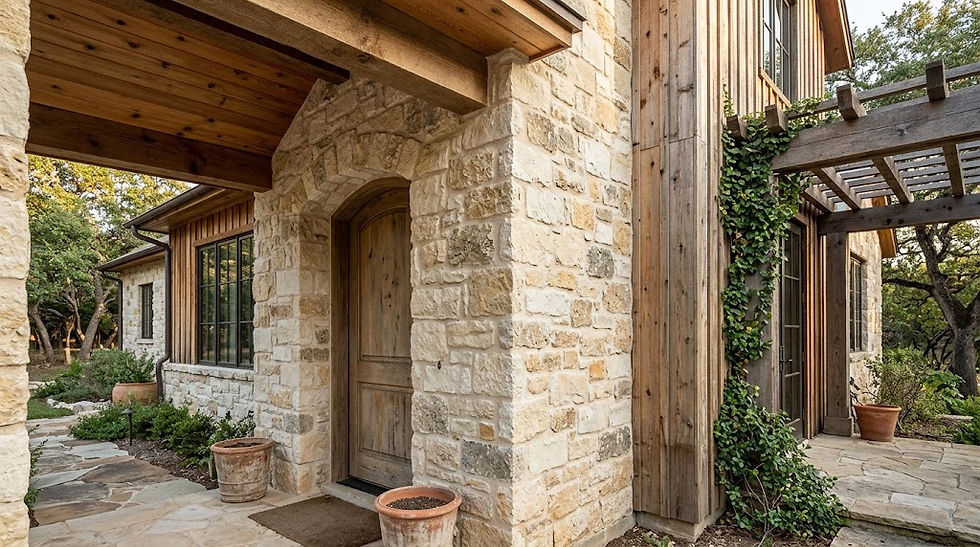
Natural wood and tumbled stone share something important.
Neither material needs to be perfectly uniform to be beautiful.
Wood has grain.
Stone has mineral variation.
Wood changes.
Stone weathers.
Together, they can create a material palette that feels natural rather than manufactured.
Potential combinations include:
Stone + timber beams
Stone + wood siding
Stone + wood soffits
Stone + wood entry doors
Stone + pergolas
Stone + exterior screens
Warm cream, beige, buff, and gray-beige stones can work especially well with natural wood tones.
Dark Metal Gives Tumbled Stone a Modern Edge
Now introduce black or dark bronze metal.
The effect changes.
Dark windows can provide sharp definition against the softer stone.
Metal roofing can introduce clean geometry.
Steel can create precise architectural lines.
The contrast works because the materials don't try to perform the same visual role.
Tumbled stone provides softness, texture, and mass.
Metal provides precision and contrast.
That relationship is one reason tumbled stone can work so well in transitional and contemporary architecture.
Tumbled Stone Can Extend into the Landscape

The strongest stone designs often don't stop at the exterior wall.
The same or related material may continue into:
Entry walls
Garden walls
Outdoor fireplaces
Outdoor kitchens
Columns
Seating walls
Pool structures
Landscape features
This creates continuity between architecture and site.
The house doesn't feel like an object placed on the landscape.
The materials begin connecting the two.
Tumbled stone can be especially effective here because its softened character already feels compatible with natural surroundings.
Outdoor Fireplaces Are an Ideal Application
Few architectural elements benefit from texture and mass like an outdoor fireplace.
A tumbled natural stone fireplace can become the anchor of an outdoor living area.
The irregular surface catches changing sunlight.
Mortar creates depth.
Large stones provide mass.
Smaller pieces create texture.
Wood, metal, and landscaping can surround it naturally.
And because the fireplace is often viewed from relatively close distances, craftsmanship becomes particularly noticeable.
This is where the details matter.
Corners Can Make or Break the Illusion

A stone wall shouldn't look like a thin surface pasted onto the building.
Corners play an important role in creating visual depth.
For natural thin veneer applications, appropriate corner pieces can help maintain the appearance of full-depth masonry.
But corners also need to maintain the same:
Pattern
Stone-size distribution
Mortar treatment
Texture
Character
as the rest of the wall.
This becomes particularly important with tumbled and overgrouted installations.
The wall should turn the corner naturally.
Windows and Doors Need to Belong to the Stone
Openings are where masonry details become obvious.
The project team needs to consider how stone terminates around:
Windows
Doors
Arches
Garage openings
Exterior niches
Depending on the architecture, this may involve:
Stone returns
Sills
Headers
Lintels
Trim pieces
Custom fabrication
Tumbled fieldstone combined with highly precise openings can create a beautiful contrast.
But those conditions need to be designed.
Tumbled Stone Still Requires Good Wall Design

A beautiful finish doesn't replace building science.
Exterior stone veneer still needs to be part of a properly designed wall assembly.
Depending on the system and project, considerations may include:
Substrate
Weather-resistive barriers
Drainage
Flashing
Weeps
Mortar or attachment systems
Anchoring
Movement
Openings
Penetrations
Terminations
For projects in the Southeast, moisture management is especially important because walls may experience substantial rainfall, humidity, heat, and wind-driven rain.
The stone is the visible layer.
Performance depends on the complete assembly behind and around it.
Full-Bed or Thin Veneer?
Tumbled natural stone can potentially be incorporated into either full-depth masonry or natural thin veneer systems depending on the material and project.
The choice affects much more than appearance.
It can influence:
Wall thickness
Structural support
Foundation conditions
Window details
Door details
Transitions
Corners
Installation
Freight
Construction sequencing
That's why veneer thickness should be established early enough for the architectural details to respond to it.
A rendering may look identical.
The wall section won't.
Natural Variation Is Part of the Appeal

Tumbling doesn't eliminate natural variation.
Nor should it.
Individual pieces may differ in:
Color
Texture
Mineral characteristics
Fossils
Surface markings
Edge character
That's part of what gives natural stone its depth.
For significant projects, don't approve the material from one carefully selected piece.
Review:
Multiple samples
Range samples
Sample boards
Larger mockups
Completed installations when available
The goal is to understand what the stone can naturally do.
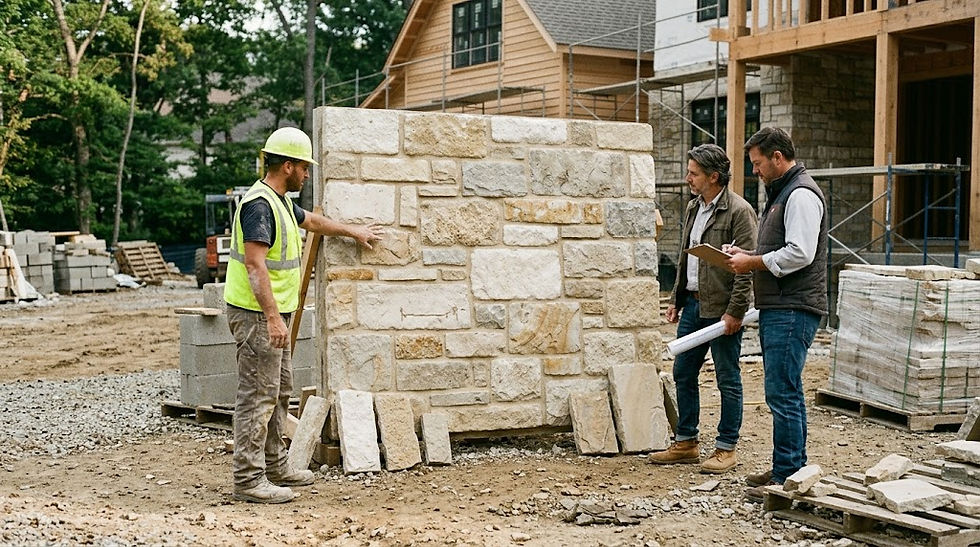
Build the Mockup Before You Build the House
Tumbled stone is one of the best examples of why masonry mockups matter.
A loose sample can show color and texture.
It cannot fully demonstrate the wall.
A mockup can show:
Stone + size + pattern + mortar + joint + craftsmanship.
For important projects, consider building alternatives.
One panel might have more restrained joints.
Another might use wider cream joints.
Another might demonstrate an overgrouted treatment.
Now the owner, architect, designer, builder, and mason can evaluate the actual architectural direction together.
Look at the Mockup from More Than Five Feet Away
Close inspection matters.
So does architectural distance.
Look at the mockup up close to evaluate:
Texture
Mortar
Edges
Craftsmanship
Then move back.
Look from:
10 feet
25 feet
50 feet
If possible, look at it in morning and afternoon light.
Tumbled stone is highly affected by shadow.
The surface you see at noon may feel different late in the afternoon.
That's part of its character.
Establish a Visual Standard for the Mason
Terms such as:
"Tumbled."
"Rustic."
"Old-world."
"European."
can mean different things to different people.
The mason needs more than adjectives.
An approved mockup can establish:
Stone distribution
Pattern
Joint width
Mortar color
Mortar coverage
Overgrouting
Corner treatment
Overall character
Once approved, that wall becomes the target.
That's much clearer than asking someone in the field to interpret an inspiration photograph.
The 2026 Trend Isn't Really About Making Stone Look Old
This distinction matters.
The appeal of tumbled stone isn't simply nostalgia.
It's part of a larger movement toward materials that show:
Texture
Variation
Craftsmanship
Natural character
Depth
A contemporary home can benefit from those qualities just as much as a European-inspired residence.
The difference is how they're expressed.
Traditional architecture might combine tumbled stone with wider mortar joints and more irregular sizing.
Contemporary architecture might combine the same material character with larger pieces, controlled joints, black windows, and simple detailing.
The material has history. The architecture decides what to do with it.
The Hunter Stone Approach: Design the Wall, Not Just the Veneer
At Hunter Stone, when someone asks us for tumbled stone veneer, we want to know what they're actually trying to create.
Do you want:
A refined warm-neutral wall?
An aged European appearance?
A substantial Texas or Southern residence?
A contemporary home with natural texture?
An outdoor fireplace that feels like it has always been there?
Those answers influence much more than which stone we send as a sample.
They can influence:
Stone type
Color range
Stone sizes
Pattern
Thickness
Mortar color
Joint width
Joint treatment
Corner conditions
Fabricated pieces
Mockups
Hunter Stone can assist architects, designers, builders, contractors, masons, developers, and homeowners with:
Tumbled natural stone
Tumbled limestone
Full-bed stone
Natural thin veneer
Stone sizing
Pattern development
Mortar coordination
Joint concepts
Range samples
Sample boards
Mockups
Corner pieces
Sills
Headers
Wall caps
Fireplace stone
Custom fabrication
CAD and shop drawings
Takeoffs
Submittals
Installation recommendations
Mason coordination
Field coordination
Packaging and logistics
Considering Tumbled Stone Veneer for a Project?
Don't begin with:
"Send me your most popular tumbled stone."
Begin with:
"This is what we're trying to create."
Send Hunter Stone your:
Plans
Elevations
Wall sections
Renderings
Inspiration photographs
Exterior material palette
Window selections
Roofing
Wood finishes
Metal finishes
Mortar inspiration
Then we can help develop the stone wall around the architecture rather than trying to make the architecture fit a random stone sample.
Because the reason tumbled stone veneer stands out in 2026 isn't that it's a new material.
It's almost the opposite.
It brings back texture.
It brings back variation.
It brings back visible craftsmanship.
And in an era when so many building products are designed to look perfectly identical, tumbled natural stone offers something very different:
A wall that doesn't have to be perfect to be beautiful.
Hunter StoneArchitectural Design-Assist Stone Partner for Complex Projects
Natural Stone | Cast Stone | GFRC | Custom Fabrication | Design Assist


Comments