



The 10 Biggest Natural Stone Trends Shaping Homes in 2026

Natural stone is changing.
Not because architects and homeowners suddenly discovered stone.
We've been building with it for thousands of years.
What's changing in 2026 is how we're using it.
The movement isn't toward one particular limestone, one color, or one architectural style.
Instead, we're seeing a broader shift toward homes that feel:
Warmer.
More natural.
More textured.
More permanent.
More connected to craftsmanship.
After years of highly uniform materials and cool minimalist palettes, designers are embracing variation again.
They're increasing the scale of stone.
They're mixing stone with wood and metal.
They're bringing substantial fireplaces back into interiors.
They're allowing mortar to become part of the design.
They're extending stone from the architecture into the landscape.
And increasingly, they're looking for materials that don't just photograph well when the project is completed—they want materials that can age well with the building.
At Hunter Stone, these are some of the most important natural stone directions we're seeing influence residential architecture in 2026.
Quiet-Luxury Limestone

One of the strongest movements in residential design is also one of the least visually aggressive.
Quiet luxury.
Rather than relying on dramatic colors or overly complicated material palettes, quiet-luxury architecture emphasizes:
Material quality
Proportion
Craftsmanship
Subtle texture
Natural variation
Refined detailing
Limestone fits naturally into this approach.
Cream, buff, warm white, beige, taupe, and soft-gray limestones can create architecture that feels substantial without being visually loud.
The stone doesn't need extreme contrast.
Its beauty can come from subtle differences between individual pieces, surface texture, shadow, scale, and fabrication.
This is particularly effective when limestone is paired with:
Natural wood
Bronze
Dark metal
Plaster
Glass
Restrained landscaping
The objective isn't to make the stone the loudest element on the building.
It's to make the architecture feel better because the stone is there.
Natural Neutrals Are Replacing Cold Gray Palettes

Gray isn't disappearing.
But the way designers are approaching neutral colors is changing.
Instead of relying heavily on cool blue-grays, we're seeing greater interest in:
Cream
Warm white
Buff
Sand
Beige
Mushroom
Taupe
Soft brown
Warm gray
Muted gold
The result is still neutral architecture.
It's simply warmer.
Natural stone works particularly well with this shift because many stones contain several of these colors simultaneously.
A limestone may read as beige from a distance while revealing cream, gray, buff, fossil, and mineral variation up close.
That complexity is difficult to reproduce with a completely uniform manufactured surface.
The new neutral isn't necessarily one color.
It's a range of related natural colors.
Larger Stone Is Changing the Scale of the Wall

Stone is getting bigger.
Architects are increasingly exploring:
Larger rectangular pieces
Long-format stone
Large limestone panels
Oversized fireplace pieces
Large paving units
Custom cut-to-size stone
Why?
Because the buildings are getting larger too.
Tall ceilings, large windows, broad exterior walls, expansive openings, and open interior spaces can make small stone patterns appear visually busy.
Larger pieces can respond to that scale.
Fewer joints can create calmer surfaces.
Long horizontal pieces can emphasize the width of a residence.
Tall pieces can reinforce vertical architecture.
Large panels can create a more monolithic appearance.
But increasing stone size also changes the technical conversation.
Now the project team needs to consider:
Weight
Thickness
Stone properties
Anchoring
Substrate
Fabrication
Tolerances
Handling
Crating
Transportation
Installation
Large-format stone isn't simply small stone made bigger.
It needs to be designed as a system.
Tumbled and Weathered Stone Is Bringing Back Character

Perfect edges aren't always the objective anymore.
We're seeing renewed interest in stone that feels:
Softer
Aged
Handcrafted
Weathered
Established
Tumbled stone is particularly effective because the finishing process can soften sharp edges and introduce a more relaxed character.
Pair that with cream, beige, buff, warm gray, or taupe limestone and the material can feel as though it has been part of the architecture much longer than it actually has.
This works naturally with:
English Country
French Country
European-inspired homes
Mediterranean architecture
Traditional Southern homes
But tumbled stone isn't limited to traditional architecture.
Use larger tumbled pieces with dark windows, simple rooflines, and contemporary detailing and the result can become surprisingly modern.
Old-world material character and contemporary architecture can coexist.
Mortar Is Becoming Part of the Design
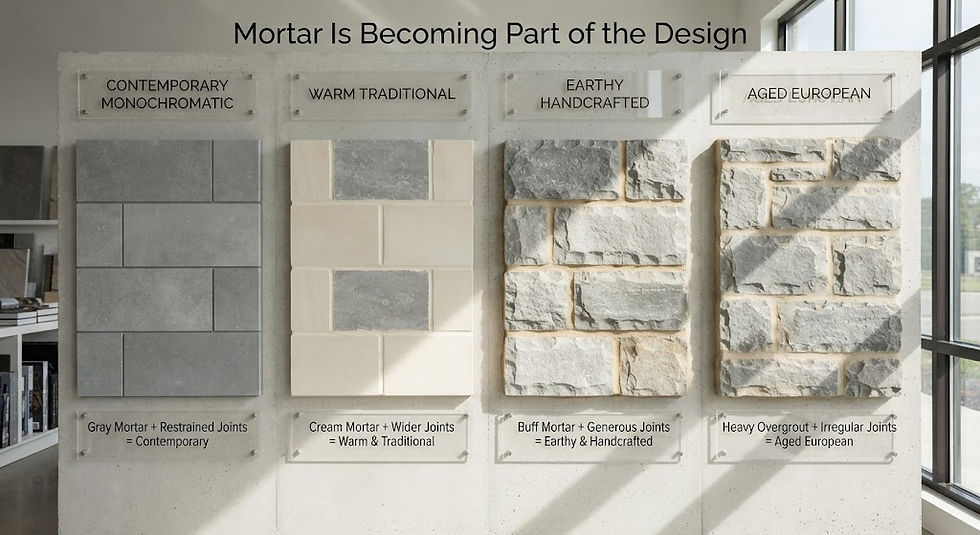
For years, stone received most of the attention while mortar was often treated as a construction decision.
That's changing.
Architects and designers are recognizing that mortar can dramatically influence the appearance of natural stone.
Take one gray stone.
Install it with:
Gray mortar and restrained jointsand it can feel contemporary and monochromatic.
Use:
Cream mortar and wider jointsand the same stone can feel warmer and more traditional.
Use:
Buff mortar and generous jointsand it can begin feeling earthy and handcrafted.
Use:
A heavy overgroutand the stone may take on an aged European character.
The same applies to white and beige stone.
Mortar can:
Warm the wall
Cool the wall
Increase contrast
Reduce contrast
Highlight individual stones
Blend pieces together
Change the perceived scale of the pattern
That's why one of the most important stone trends of 2026 isn't actually stone.
It's designing the space between the stones.
Mixed Materials Are Becoming More Sophisticated

Stone isn't being asked to carry the entire exterior anymore.
Some of the strongest homes use a deliberately limited combination of materials.
One particularly effective formula is:
Stone + wood + metal.
Each material performs a different visual role.
Stone provides mass and permanence.
Wood provides warmth.
Metal provides precision and contrast.
Glass may provide transparency between them.
The result can feel richer than an exterior using five or six competing finish materials.
But mixed-material architecture requires careful transitions.
The design team needs to resolve how stone meets:
Wood siding
Metal panels
Windows
Glass
Stucco
Plaster
Roofing
Concrete
Thicknesses change.
Materials move differently.
Drainage conditions change.
Joint requirements change.
A rendering can show materials touching beautifully.
Construction details have to explain how they actually meet.
The Fireplace Is Becoming Architecture Again
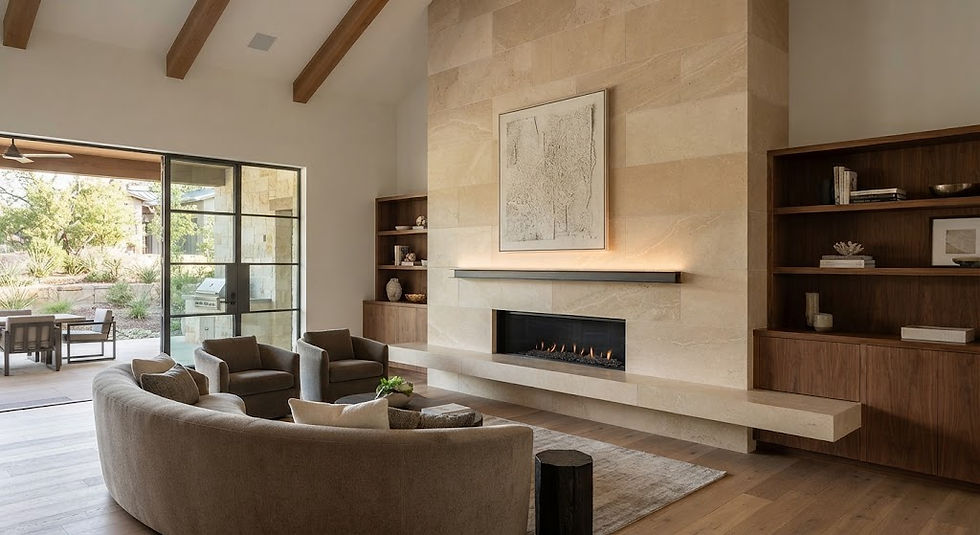
For years, many residential fireplaces became increasingly minimal.
Firebox.
Simple surround.
Television above.
Done.
In 2026, we're seeing renewed interest in fireplaces that establish the architecture of the room.
That includes:
Substantial limestone mantels
Floor-to-ceiling stone
Solid fabricated pieces
Long stone hearths
Carved surrounds
Monumental fireplaces
Sculptural contemporary compositions
Some designs are highly traditional.
Others use only a handful of large stone pieces.
The common theme is architectural presence.
The fireplace becomes something the room responds to.
Furniture arrangements respond to it.
Millwork relates to it.
Ceiling proportions matter.
Artwork and lighting relate to it.
The mantel is no longer something added around a firebox after the room has been designed.
The fireplace becomes part of the room's architecture from the beginning.
Custom-Carved and Fabricated Stone Is Becoming Personal Again

One of the most exciting directions in high-end residential architecture is the return of custom stone fabrication.
Instead of selecting every element from a standard catalog, architects and homeowners can create stone specifically for the project.
That may include:
Fireplace mantels
Door surrounds
Window surrounds
Columns
Sills
Headers
Lintels
Wall caps
Steps
Hearths
Arches
Moldings
Carved panels
Family crests
Monograms
Custom profiles
Modern fabrication technology makes this especially interesting.
Architectural drawings can become CAD files.
Field dimensions can be captured digitally.
Complex elements can be modeled in 3D.
CNC fabrication can produce precise geometry.
Craftsmen can then finish and refine the stone.
It's a combination of old and new:
Digital precision + traditional craftsmanship.
The result can be something increasingly rare in construction:
An architectural element that belongs specifically to one building.
Outdoor Living Is Becoming an Extension of the House

Outdoor living isn't being designed as leftover space behind the home anymore.
It's becoming another architectural environment.
Today's projects may include:
Outdoor kitchens
Covered living rooms
Fireplaces
Fire pits
Pool areas
Courtyards
Terraces
Outdoor bars
Pavilions
Seating walls
Garden walls
Steps
Landscape features
Natural stone can connect these spaces to the house.
Exterior wall stone might continue onto an outdoor fireplace.
A related limestone might become the paving.
Stone caps may finish landscape walls.
Large stone treads can connect changes in elevation.
Pool coping can coordinate with the architectural palette.
The objective isn't to cover everything in stone.
It's to use stone strategically so the architecture and landscape feel related.
The property becomes one composition instead of a house surrounded by separate outdoor features.
Indoor-Outdoor Material Continuity Is Getting Stronger

Large glass doors and disappearing wall systems are changing the relationship between interior and exterior architecture.
When a wall opens completely, interior and exterior materials are seen at the same time.
That makes material coordination more important.
Designers may use:
Related interior and exterior stone
Similar paving colors
Stone fireplaces inside and outside
Exterior stone extending into protected interior areas
Coordinated hearth and terrace materials
The materials don't necessarily need to match exactly.
In fact, sometimes they shouldn't.
Exterior conditions may require different finishes, thicknesses, or stone characteristics.
The objective is visual continuity, not forcing one material to perform every job.
Natural Variation Is Becoming a Feature Instead of a Defect

This may be one of the most important changes in how people think about natural materials.
For years, material selection often focused heavily on consistency.
Every piece was expected to resemble the sample.
But that's not how geology works.
Natural stone may contain:
Color variation
Fossils
Veining
Mineral deposits
Bedding
Texture
Natural markings
Increasingly, designers are embracing these characteristics.
Instead of asking:
"How do we make every stone identical?"
the conversation becomes:
"What range of natural variation works for this architecture?"
That's a much better question.
Because once you accept variation, the wall gains depth.
Sunlight interacts differently with individual pieces.
Colors shift subtly across the elevation.
The building changes depending on distance and time of day.
Natural variation becomes part of the design.
The Trend Behind All 10 Trends: Design the Wall, Not Just the Stone

Look closely at these 2026 trends and you'll notice something.
They aren't really about choosing one fashionable stone.
They're about designing stone more intentionally.
Large-format stone requires panel planning.
Tumbled stone requires joint consideration.
Warm neutrals require understanding undertones.
Mixed materials require transition details.
Fireplaces require scale and fabrication.
Outdoor living requires application-specific materials.
Custom stone requires drawings and coordination.
Natural variation requires range approval.
Mortar requires mockups.
Everything is connected.
That's why the old material-selection process:
Pick a stone sample → get a price → order the stone
isn't enough for complex architectural projects.
The better process is:
Understand the architecture → establish design intent → select the stone → determine size and pattern → coordinate mortar and joints → develop details → create samples or mockups → prepare shop drawings where required → fabricate → coordinate installation.
That's design-assist.
Don't Select Stone from a Photograph Alone

Pinterest, Instagram, Houzz, architectural magazines, and renderings are excellent sources of inspiration.
But photographs don't tell you everything.
A photograph doesn't necessarily tell you:
Stone type
Thickness
Actual dimensions
Finish
Mortar color
Joint width
Installation system
Corner condition
Fabrication
Water management
Structural support
Use photographs to communicate the design direction.
Then develop the actual stone system for the project.
Samples Need to Show Range
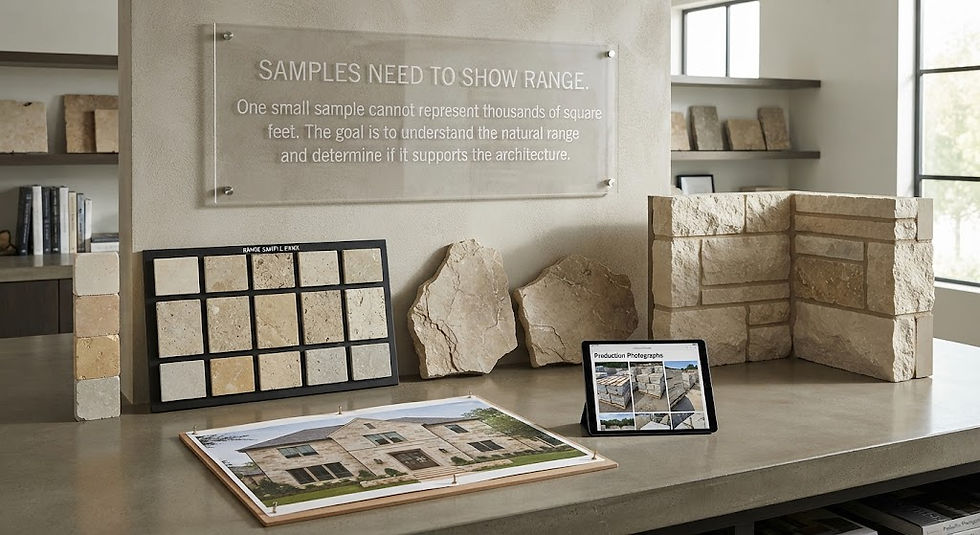
One small sample cannot represent thousands of square feet of natural stone.
For important projects, consider evaluating:
Multiple samples
Range samples
Sample boards
Larger pieces
Mockups
Completed installations
Production photographs
The goal shouldn't be to approve one perfect piece.
It should be to understand the natural range and determine whether that range supports the architecture.
Mockups Are Becoming More Important
As stone design becomes more sophisticated, mockups become increasingly valuable.
A good mockup can demonstrate:
Stone color range
Stone sizes
Pattern
Mortar color
Joint width
Joint profile
Texture
Corner conditions
Adjacent materials
For a mixed-material exterior, the mockup might also include:
Wood
Metal
Stucco
Window finish
Now the design team isn't approving isolated samples.
They're approving relationships between materials.
That's much closer to how the finished building will actually be experienced.
Stone Performance Still Matters

Design trends don't eliminate technical requirements.
Natural stone needs to be appropriate for the application and environment.
Depending on the project, considerations may include:
Absorption
Density
Strength
Freeze-thaw exposure
Moisture
Wind
Salt exposure
Heat
Surface finish
Slip resistance
Anchoring
Substrate
Drainage
Flashing
A beautiful stone isn't automatically the right stone for every location.
This becomes especially important when the same project includes wall veneer, paving, pool areas, steps, fireplaces, and landscape features.
Each application needs to be evaluated individually.
2026 Is Less About Trends and More About Permanence

There's an interesting contradiction in writing about stone trends.
Natural stone is one of the oldest building materials on earth.
Cream limestone isn't new.
Large stone isn't new.
Carved mantels aren't new.
Tumbled stone isn't new.
Stone courtyards aren't new.
What changes is how each generation interprets these materials.
In 2026, that interpretation appears to be moving toward:
Natural materials.
Warmer palettes.
Greater texture.
Larger scale.
Better craftsmanship.
More customization.
Stronger indoor-outdoor relationships.
Materials that age rather than simply go out of style.
That's what makes this moment in natural stone design interesting.
We're not necessarily inventing something new.
We're rediscovering why these materials have worked for centuries.
The Hunter Stone Approach: Start with the Architecture
At Hunter Stone, we don't believe the first conversation should always be:
"Which stone do you want?"
Sometimes the better question is:
"What are you trying to create?"
Show us the architecture.
Show us the elevations.
Show us the rendering.
Show us the inspiration photograph.
Show us the wood, metal, roofing, windows, and landscape materials.
Then we can begin evaluating the stone as part of the complete design.
Hunter Stone can assist architects, interior designers, landscape architects, builders, contractors, masons, developers, and homeowners with:
Natural stone sourcing
Full-bed stone
Natural thin veneer
Large-format stone
Limestone
Sandstone
Granite
Tumbled stone
Pavers
Cobblestone
Fireplace mantels
Hearths
Steps
Caps
Sills
Headers
Lintels
Architectural surrounds
Custom-carved stone
Custom fabrication
Cast stone
GFRC
CAD drawings
Shop drawings
3D coordination
Laser field measurements
Takeoffs
Samples
Range samples
Mockups
Submittals
Installation recommendations
Field coordination
Packaging
Logistics
Planning a Natural Stone Project in 2026?
Don't wait until every architectural detail has already been finalized to begin discussing stone.
Send Hunter Stone your:
Plans
Elevations
Wall sections
Details
Renderings
Inspiration photographs
Material palette
Specifications
You don't need to have the stone figured out.
That's often the best time to start the conversation.
We can help evaluate stone type, thickness, size, pattern, texture, mortar, joints, custom fabrication, corners, architectural details, samples, mockups, shop drawings, and logistics before those decisions become expensive to change.
Because the biggest natural stone trend of 2026 may ultimately be the simplest:
We're designing with stone again—not simply applying it to buildings.
And that's a trend worth keeping long after 2026 is over.
Hunter StoneArchitectural Design-Assist Stone Partner for Complex Projects
Natural Stone | Cast Stone | GFRC | Custom Fabrication | Design Assist


Comments