



Why Limestone Is the “Quiet Luxury” Material of 2026

The most luxurious homes don't always announce their luxury. Sometimes, the material speaks for itself.
For years, luxury residential design was defined by dramatic finishes, bold contrasts, highly polished surfaces, and materials meant to grab immediate attention.
But a different approach to luxury is influencing architecture in 2026.
It's quieter.
More natural.
More intentional.
Instead of relying on materials that dominate a space, architects and designers are increasingly exploring materials that create atmosphere through texture, proportion, authenticity, and craftsmanship.
And few materials express this design philosophy as naturally as limestone.
With its soft colors, subtle geological variation, and remarkable architectural versatility, limestone can make a home feel sophisticated without appearing overly designed.
It can create warmth without relying on bright colors.
It can provide visual interest without excessive pattern.
It can also establish a sense of permanence without demanding attention.
That is the essence of quiet luxury.
At Hunter Stone, we believe limestone's appeal in 2026 represents something larger than another exterior design trend.
It reflects a renewed appreciation for authentic materials and architecture designed to remain beautiful long after today's trends have changed.
What Is Quiet Luxury in Architecture?

Quiet luxury isn't simply minimalism.
And it isn't necessarily about expensive materials.
It's a design philosophy built around restraint, quality, proportion, and thoughtful detailing.
Instead of emphasizing decoration, quiet luxury emphasizes the architecture itself.
A quiet luxury home may incorporate:
Natural limestone
Warm wood
Soft plaster
Restrained metal finishes
Large windows
Carefully proportioned openings
Simple architectural forms
Subtle material transitions
The result feels refined rather than extravagant.
Materials are selected because of how they work together, not because each one needs to make a statement.
Quiet luxury is what happens when quality replaces visual excess. Limestone works especially well because it has enough natural character to be interesting without extra ornamentation.
Why Limestone Fits the Quiet Luxury Movement
Limestone has a quality many manufactured materials try to replicate: natural variation.
Natural variation.
Depending on its geological source, limestone may contain subtle combinations of:
Warm white
Cream
Ivory
Buff
Beige
Taupe
Soft gray
Muted gold
These colors often appear together, not as perfectly uniform surfaces.
That creates visual depth.
A limestone wall can look simple from a distance, yet reveal remarkable complexity up close.
Small changes in mineral composition, fossil content, and texture give each piece its own character.
The beauty isn't always dramatic.
Sometimes it's barely noticeable until sunlight moves across the wall.
Limestone doesn't need a bold pattern to create architectural interest.
Its natural character does that work.
The Shift Away from Trend-Driven Materials

Every design generation develops materials and finishes that become widely associated with its era.
Some age beautifully.
Others quickly reveal when a building was constructed.
The risk isn't necessarily the material itself.
It's the way that material is used.
Highly repetitive patterns, extreme color contrasts, and overly decorative finishes can make architecture feel tied to a particular moment.
Quiet luxury takes a different approach.
Instead of asking:
“What's the most popular finish this year?”
The designer asks:
“Will this material still feel appropriate for this architecture twenty years from now?”
Limestone has an advantage because it has been used in significant architecture for centuries.
Its appeal doesn't depend on a newly invented surface pattern.
It comes from the material itself.
That doesn't mean limestone is automatically timeless in every application.
Poor proportions, inappropriate detailing, or fashionable styling can date any material.
But thoughtfully selected limestone provides an exceptionally versatile foundation for enduring architecture.
Limestone Is Beautiful Because It Isn't Perfect
One defining characteristic of natural limestone is variation.
No two pieces are necessarily identical.
Depending on the stone, individual pieces may contain:
Subtle color movement
Mineral markings
Fossils
Natural texture
Changes in grain
Soft tonal differences
These characteristics can make a limestone wall feel more authentic than a perfectly uniform manufactured surface.
In quiet luxury design, that variation becomes an asset.
The goal isn't to eliminate every difference.
It's to create a balanced composition that allows the stone's natural character to emerge.
This requires thoughtful material selection.
A single sample may not represent the complete range of a natural limestone.
For important projects, architects and homeowners should review multiple samples, range boards, or representative mockups.
The goal is not to find one perfect stone. The goal is to create a beautiful wall from a naturally varied material.
Warm Limestone Colors Are Redefining Luxury Exteriors

One of the most noticeable directions in residential architecture is the increased interest in warm, natural neutrals.
Cream.
Buff.
Sand.
Warm white.
Beige.
Taupe.
These colors can create sophisticated exteriors that feel inviting, not cold.
A warm limestone exterior may pair beautifully with:
Dark bronze windows
Natural wood soffits
Black metal roofing
Cream stucco
Warm-gray paving
Natural landscaping
The result can be contemporary without feeling stark.
Traditional without feeling dated.
Elegant without appearing overly formal.
This versatility is one reason limestone is so appealing for quiet luxury architecture.
Cream Limestone: Understated Elegance
Cream limestone works especially well when the design calls for a light, refined exterior.
Its warmth can soften large architectural forms.
In contemporary homes, you can install cream limestone in larger rectangular pieces with restrained joints.
The result is calm and sophisticated.
In traditional architecture, smaller pieces or more pronounced masonry patterns can create a different character.
The same general color family can support remarkably different architectural expressions.
The key is understanding how stone size, pattern, mortar, and detailing work together.
Buff Limestone: Warmth Without Excess
Buff limestone offers another approach to quiet luxury.
Its natural earth tones can connect a residence to the surrounding landscape.
This is especially effective for homes incorporating:
Natural wood
Timber beams
Warm metal finishes
Stone paving
Courtyards
Outdoor living spaces
Buff limestone can make substantial architecture feel grounded and approachable.
It offers warmth without relying on strong color.
And because natural buff limestone may contain subtle cream, gray, and tan variation, it can coordinate with a wide range of exterior materials.
Soft Gray Limestone Still Has a Place
Quiet luxury doesn't require every building to be beige.
Soft-gray limestone can be equally sophisticated.
The difference often lies in how designers use the gray.
Instead of combining multiple cold-gray materials into a completely monochromatic exterior, designers can introduce natural wood, warm mortar, bronze metal, or other materials that create balance.
A gray limestone with subtle warm undertones may work especially well in contemporary and transitional architecture.
The objective isn't to eliminate gray. It's to create a more thoughtful relationship between materials.
Large-Format Limestone Creates Architectural Calm

One of the most effective ways to use limestone in quiet luxury design is through larger stone pieces.
Large-format stone can create walls with fewer visible joints.
This lets the architecture's proportions and geometry take center stage.
Instead of seeing hundreds of small individual pieces, the eye reads the wall as a larger composition.
This can be especially effective on:
Entry walls
Contemporary façades
Interior feature walls
Fireplace surrounds
Courtyard walls
Architectural columns
But large-format limestone requires careful planning.
Evaluate stone dimensions, thickness, weight, support, fabrication, handling, and installation for the specific project.
When a wall has fewer joints, each joint matters more.
That is why you should coordinate large-format limestone early with the architectural design team and fabricator.
Texture Can Be More Luxurious Than Shine
Luxury isn't always associated with polished surfaces.
In fact, quiet luxury often benefits from finishes that reveal the material's natural character.
Depending on the limestone and application, finishes may include:
Honed
Brushed
Tumbled
Natural-textured
Other specialty finishes
A honed limestone may feel smooth and refined.
A brushed finish can introduce subtle surface texture.
A tumbled finish may soften the stone's edges and create a more established appearance.
A more pronounced natural texture can create shadows and visual depth.
Each finish changes how the stone interacts with light.
And light is one of the most important elements in quiet luxury architecture.
The Relationship Between Limestone and Natural Light
Limestone can change noticeably throughout the day.
Morning light may emphasize its cooler undertones.
Direct sunlight may reveal warmth.
Afternoon shadows may bring out the surface texture.
This subtle variation gives limestone a dynamic quality without requiring bold colors or patterns.
For exterior projects, the building's orientation can influence how the stone is perceived.
A north-facing wall may appear different from a south-facing elevation.
A covered entry may show different color characteristics than a wall exposed to direct sunlight.
That's why you should evaluate limestone under realistic lighting conditions whenever possible.
Limestone and Wood: A Natural Partnership

Few material combinations express quiet luxury as effectively as natural limestone and wood.
Limestone provides visual mass.
Wood introduces warmth and grain.
Together, they create a balanced composition.
Consider a residence with cream limestone walls, natural wood soffits, and dark bronze windows.
The limestone establishes the architecture.
The wood adds warmth.
The metal defines the openings.
None of the materials needs to compete for attention.
This combination works across contemporary, transitional, and traditional residential styles.
The important detail is undertone coordination.
Golden wood can work beautifully with buff limestone.
A cooler wood may pair more naturally with taupe or soft-gray stone.
Actual samples should be reviewed together.
Limestone and Metal: Softness Meets Precision
Dark metal can beautifully contrast with natural limestone.
Black and bronze windows create crisp architectural lines against the stone's softer texture.
Metal roofing can reinforce the building's geometry.
Steel details can introduce precision without excessive decoration.
This contrast is especially effective in contemporary architecture.
The limestone provides warmth and permanence. The metal provides definition.
The result can feel both modern and timeless.
Limestone Fireplaces Are Becoming Architectural Centerpieces
A fireplace is one of the most effective places to use limestone as a major architectural element.
In quiet luxury interiors, the fireplace doesn't necessarily need elaborate decoration.
A beautifully proportioned limestone surround may be enough.
Depending on the design, possibilities include:
Solid limestone mantels
Large-format stone surrounds
Custom-carved profiles
Minimalist stone panels
Floor-to-ceiling limestone walls
Traditional architectural fireplace components
The stone's scale and detailing should respond to the room.
A large room with tall ceilings may benefit from a substantial fireplace composition.
A more intimate space may require restrained proportions.
Custom limestone fireplaces can involve detailed fabrication, field measurement, structural coordination, and installation planning.
The best results come when you address these requirements before construction advances too far.
Custom Limestone Fabrication Creates Distinction

Quiet luxury is often defined by details that aren't immediately obvious.
A precisely fabricated limestone sill.
A custom header.
A carefully proportioned wall cap.
A carved fireplace profile.
A substantial stone entry surround.
These elements can create architectural distinction without excessive ornamentation.
Modern fabrication technology allows stone to be coordinated with architectural drawings and field measurements.
Depending on the project, this may include CAD modeling, shop drawings, precision cutting, and specialized finishing.
The goal isn't to complicate the stone.
It's to make the architecture more intentional.
Custom fabrication is most valuable when it improves proportion, fit, and architectural continuity.
Limestone Connects Interior and Exterior Architecture
Another important direction in luxury residential design is the desire for continuity between interior and exterior spaces.
Homes increasingly incorporate:
Large glass openings
Covered terraces
Courtyards
Outdoor fireplaces
Outdoor kitchens
Connected entertaining areas
Limestone can help establish a consistent architectural language across these environments.
Exterior wall stone may relate to an interior fireplace.
Stone used at an entry may coordinate with courtyard walls.
Related limestone colors may appear in paving or landscape features.
However, not every limestone suits every application.
Horizontal surfaces, pool areas, and exposed paving require separate evaluation of slip resistance, absorption, strength, weathering, and other performance characteristics.
Material continuity should be intentional, but performance requirements must guide the selection.
Outdoor Living Is an Extension of Quiet Luxury
Quiet luxury isn't limited to the home's interior.
Outdoor environments can express the same design philosophy.
A limestone fireplace may anchor a covered terrace.
Stone columns may support a timber roof.
Natural limestone walls may connect the house to the landscape.
Carefully selected paving may reinforce the home's material palette.
The result is an outdoor environment that feels integrated with the architecture rather than added later.
For these projects, early coordination is especially valuable.
Consider the stone's thickness, finish, support, drainage, and installation requirements as part of the overall design.
Mortar Is One of the Most Important Quiet Luxury Details

A limestone wall is never just limestone.
Mortar significantly influences the finished appearance.
Consider a warm cream limestone.
With closely matched cream mortar, the wall may appear calm and unified.
With gray mortar, individual stone pieces may stand out more.
With buff mortar, the wall may feel warmer.
With wider joints or an overgrouted treatment, the masonry may look more aged.
The same limestone can create dramatically different architectural results.
That's why you should select mortar alongside the stone.
In quiet luxury design, small details can have an enormous visual impact.
Joint Width Changes the Character of the Wall
Joint width affects how much mortar is shown
Tighter joints may create a more restrained composition.
Wider joints increase the mortar's visual presence.
The desired result depends on the architecture, stone sizing, and installation system.
A contemporary residence may benefit from a carefully organized pattern with restrained joints.
A European-inspired home may call for wider mortar joints and softened stone edges.
Neither is inherently more luxurious.
The correct approach is the one that supports the design intent.
Stone Size and Pattern Should Respond to the Building
A large residence with expansive windows may benefit from larger limestone pieces.
A smaller traditional home may look more balanced with a different size range.
Stone pattern also influences the finished appearance.
Rectangular ashlar patterns can create order.
Mixed-size patterns can introduce movement.
Tumbled irregular stone can emphasize natural character.
The design team should consider how the pattern interacts with openings, corners, columns, and changes in material.
Stone sizing should be selected at architectural scale—not just from a sample board.
Why Natural Limestone Requires Thoughtful Selection

Limestone is a natural geological material.
Its physical characteristics vary by source.
Different limestones may have different:
Strength
Density
Absorption
Porosity
Weathering characteristics
Color ranges
Surface textures
This means you must select the right limestone for the intended application.
A limestone suitable for an interior feature wall may not necessarily be appropriate for exposed exterior paving.
A material selected for a decorative surround may have different requirements from one used in a large-format exterior cladding system.
The project team should review relevant testing, applicable standards, environmental exposure, and installation requirements.
For exterior construction, proper water management remains essential.
Limestone is a durable architectural material when selected, detailed, installed, and maintained properly.
But no natural stone suits every application.
Why the Mockup Matters
A small limestone sample can demonstrate color and texture.
It cannot fully communicate the appearance of a completed wall.
A representative mockup allows the design team to evaluate:
Natural color variation
Stone sizing
Pattern
Mortar color
Joint width
Joint profile
Texture
Corner conditions
Overall craftsmanship
For quiet luxury projects, this is especially important.
When the architecture relies on restrained materials, subtle differences become more noticeable.
A mortar color that is slightly too dark may change the entire composition.
Too-small stone sizes can make the elevation feel busy.
An overly pronounced joint treatment may overwhelm the intended simplicity.
The mockup lets you resolve these decisions before installation.
Quiet Luxury Is About Designing for the Long Term
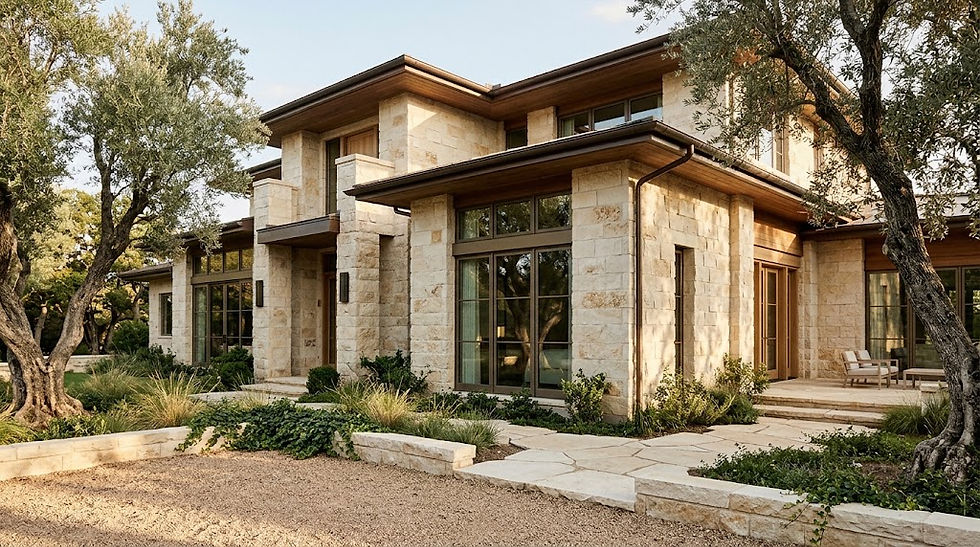
Limestone's appeal goes beyond its appearance.
It has a long architectural history.
Fabricators can shape it into both traditional and contemporary forms.
Its natural variation adds character without artificial patterns.
Its neutral color palette works with a wide range of architectural styles.
But choosing limestone alone doesn't create timeless design.
It requires thoughtful decisions about proportion, material compatibility, detailing, and performance.
A beautiful material installed without proper coordination can still produce disappointing results.
The difference is in the design.
Quiet luxury isn't the absence of detail. It's the careful control of detail.
The Hunter Stone Approach: Limestone as an Architectural Material
At Hunter Stone, we believe limestone should be considered early in the architectural design process.
Not simply as a finish selected after the building has already been designed.
The stone's thickness, size, color, texture, and fabrication requirements can influence the architecture itself.
That's why we work with architects, contractors, designers, builders, masons, developers, and homeowners as an architectural design-assist partner.
Our capabilities include:
Natural limestone sourcing
Full-bed limestone veneer
Natural thin limestone veneer
Stone color and finish selection
Custom stone sizing
Architectural pattern development
Custom fabrication
Fireplace mantels and surrounds
Sills, headers, lintels, and caps
CAD and shop drawings
3D coordination
Field measurement support
Takeoffs and quantity review
Range samples and mockups
Submittals
Installation recommendations
Mason coordination
Field coordination
Packaging and logistics
Our goal is to help the project team create architecture that is both beautiful and buildable.
Planning a Limestone Project in 2026?
If you're designing a new home, renovating an existing residence, or developing a luxury residential project, consider limestone early in the process.
Send Hunter Stone your:
Architectural plans
Elevations
Wall sections
Renderings
Inspiration photographs
Exterior material palette
Window and roofing selections
Fireplace designs
Custom stone details
We can help evaluate limestone colors, finishes, thicknesses, patterns, fabricated components, and the coordination required for the project.
Because the most successful limestone designs don't begin with a question about price per square foot.
They begin with a vision for the architecture.
And that brings us back to quiet luxury.
It's not about making the loudest statement.
It's not about selecting the trendiest finish.
And it's not about filling a building with expensive materials simply because they're expensive.
It's about choosing authentic materials that support thoughtful architecture.
Limestone doesn't need to compete for attention.
Its beauty is in its restraint.
And that's why limestone is one of the most compelling materials for quiet luxury design in 2026.
Hunter StoneArchitectural Design-Assist Stone Partner for Complex Projects
Natural Stone | Cast Stone | GFRC | Custom Fabrication | Design Assist


Comments