



Mixing Stone with Wood and Metal: The Designer's Guide to Mixed-Material Exteriors

Look at many of today's most compelling custom homes, and you'll notice something:
The exterior isn't relying on a single material.
Natural stone is being paired with warm wood siding.
Limestone is meeting dark metal panels.
Heavy masonry walls are sitting beneath wood soffits and expansive glass.
Stone columns are being combined with steel beams.
Traditional materials are being used in surprisingly contemporary ways.
Mixed-material architecture has become an important part of residential design in 2026.
But there's a difference between a house that uses several materials and a house where those materials actually work together.
The best mixed-material exteriors don't feel like a collection of finishes.
They feel like one piece of architecture.
At Hunter Stone, we believe that starts by understanding what each material contributes—and designing the transitions between them before construction begins.
Here's what architects, designers, builders, and homeowners should consider when combining natural stone, wood, and metal on a residential exterior.
Give Each Material a Job

One of the easiest ways a mixed-material exterior becomes visually complicated is using materials without a clear reason.
Stone here.
Wood there.
Metal somewhere else.
Eventually, the elevation can begin to look like a material showroom.
Instead, give each material a purpose.
Stone can provide:
Visual weight
Permanence
Texture
Connection to the landscape
A strong architectural base
Wood can provide:
Warmth
Natural color
Softer texture
Human scale
Contrast against masonry
Metal can provide:
Precision
Thin profiles
Strong lines
Contemporary contrast
Definition
Think about the architectural hierarchy first.
Which material anchors the building?
Which material provides warmth?
Which material provides contrast?
Once you establish those roles, the material palette becomes much easier to control.
Let Stone Anchor the Architecture
Natural stone has visual mass.
Use that to your advantage.
Stone often works beautifully at portions of the building that visually need to feel grounded:
Foundations
Lower walls
Entry masses
Chimneys
Columns
Piers
Retaining walls
Landscape walls
Courtyards
Outdoor fireplaces
This doesn't mean stone always has to stop at the first floor.
A stone wall extending two stories can create an incredibly strong architectural element.
The principle is about visual weight, not simply elevation.
Ask:
Where does the architecture need mass?
That may be where the stone belongs.
Use Wood to Warm the Stone

Stone and wood have been used together for centuries.
The combination still works for a reason.
Both are natural materials, but they have very different visual characteristics.
Stone feels heavy.
Wood feels lighter.
Stone can feel cool.
Wood introduces warmth.
Stone has irregular geological variation.
Wood has grain and directional movement.
Together, they create contrast without necessarily competing.
Wood can work especially well adjacent to stone on:
Soffits
Ceilings
Entryways
Gables
Siding
Garage doors
Screen walls
Covered terraces
Outdoor living areas
One particularly effective approach is using stone for the major architectural masses and wood selectively where people physically interact with the building.
That can make a large residence feel more inviting.
Use Metal for Definition

Metal can play a very different role.
Where stone and wood bring natural variation, metal can introduce precision.
Dark metal elements can define:
Window openings
Roof edges
Canopies
Railings
Fascia
Gutters
Downspouts
Wall panels
Structural elements
Architectural reveals
Metal can create a crisp line against a textured stone wall.
That contrast can be extremely effective.
But it needs restraint.
If stone is the primary material, metal may work best as the element that frames and defines rather than competing for attention.
Don't Select Each Material Separately
This is one of the most important recommendations in this article.
Don't select the stone in one meeting, the wood three months later, and the metal color after that.
Evaluate them together.
A warm limestone may look completely different next to honey-colored wood than it does next to dark-stained wood.
A cool gray stone may react differently beside bronze metal than black metal.
Natural materials also change dramatically depending on the light.
Build a material palette that includes actual samples of:
Stone
Mortar
Wood
Wood stain
Metal
Roofing
Window finish
Stucco or plaster
Paint
Paving
Then look at everything together.
And don't evaluate it only under office lighting.
Take the samples outside.
Review exterior materials under exterior light.
Mortar Is Part of the Color Palette
Mortar is sometimes treated as a technical necessity.
Architecturally, it's much more than that.
Mortar color and joint style can significantly change how natural stone reads.
The same stone installed with lighter mortar can look completely different when installed with darker mortar.
Joint width matters too.
Depending on the stone and architectural style, designers may explore:
Tight joints
Standard raked joints
Flush joints
Overgrouted joints
Wider traditional joints
The mortar can emphasize each stone or help the wall blend visually into a larger mass.
When coordinating stone with wood and metal, include mortar in the material discussion from the beginning.
Don't approve the stone and leave the mortar decision for the jobsite.
Pay Attention to Undertones
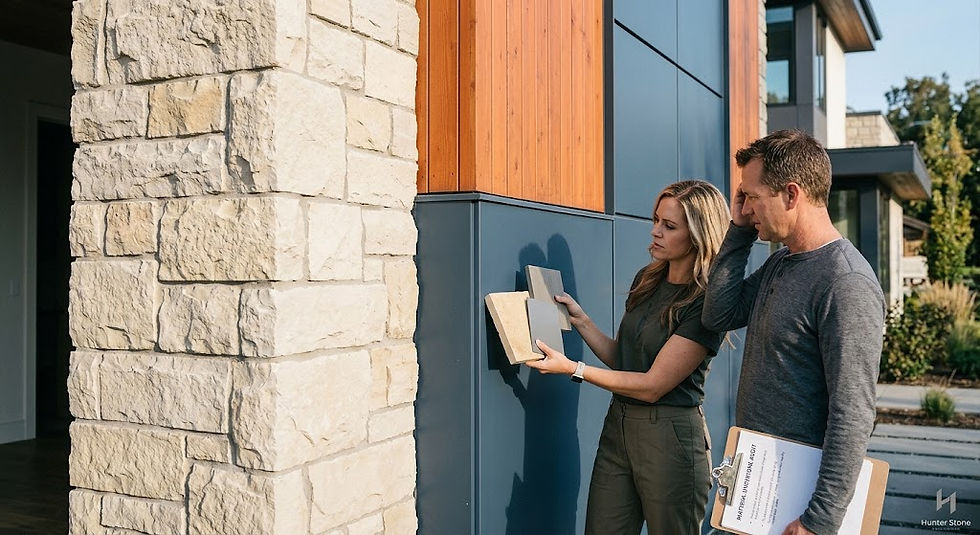
This is where mixed-material palettes can quietly go wrong.
Two materials may both appear "gray" but have completely different undertones.
A limestone might lean warm.
The metal might lean blue.
The wood might introduce red or orange.
Individually, each material may look beautiful.
Together, something feels wrong.
That's why designers should evaluate the undertones within the entire exterior palette.
Natural stone can contain subtle variations of:
Cream
Buff
Gray
Taupe
Brown
Gold
Charcoal
Rust
Wood species and stains introduce another range of colors.
Metal finishes add another.
The materials don't have to match.
In fact, they usually shouldn't.
But they should feel intentional together.
Texture Needs Balance Too
Color isn't the only relationship to consider.
Texture matters.
Imagine an exterior using:
Heavily textured stone
Highly figured wood
Strongly ribbed metal siding
All three materials demand attention.
The elevation may become visually exhausting.
Instead, consider contrast.
A rough natural stone might pair beautifully with smooth wood siding and clean metal windows.
A smoother limestone might work with more textured wood.
Broad, simple metal surfaces might balance a highly linear stone pattern.
Mixed-material design works best when it has a clear hierarchy.
Not every material needs to be the star.
Stone Size Should Respond to the Building
Stone scale matters enormously on mixed-material exteriors.
A large residence with expansive windows, broad rooflines, and substantial wood siding may overwhelm very small stone pieces.
Likewise, extremely large-format stone may feel out of scale on a smaller residence.
Evaluate:
Stone heights
Stone lengths
Pattern
Joint width
Wall dimensions
Ceiling heights
Window dimensions
Column widths
Roof scale
This is one reason a small stone sample can be misleading.
A 12-inch sample tells you about the stone.
It doesn't necessarily tell you about the wall.
For significant projects, larger-range samples and mockups can provide a much better sense of scale.
The Transition Is Where Good Design Becomes Good Construction

Here's where mixed-material architecture gets serious.
Eventually:
Stone has to meet wood.
Stone has to meet metal.
And those transitions need to work technically and visually.
The detail may need to address:
Material thickness
Drainage
Flashing
Water-resistive barriers
Air gaps
Rainscreen systems
Sealant joints
Expansion and movement
Fasteners
Anchors
Terminations
Clearances
Substrate changes
Stone, wood, and metal do not behave identically.
They have different installation requirements and can respond differently to temperature, moisture, and movement.
That's why you should draw and detail the meeting point between materials.
Don't leave it to someone standing on scaffolding to decide.
Avoid the "Stone Stuck to the Wall" Look
Natural stone should feel integrated into the building.
Not pasted onto it.
One challenge with veneer systems is making sure the architecture visually supports the material.
Pay particular attention to:
Outside corners
Window returns
Door openings
Wall ends
Parapets
Columns
Piers
Arches
Caps
Sills
Headers
Proper corner pieces and fabricated architectural elements can help create believable depth.
The goal is for someone looking at the completed house to see:
stone architecture.
Not simply stone covering.
Windows Are Critical to the Composition
Windows are often where stone, wood, and metal come together.
A dark metal window surrounded by warm limestone can be beautiful.
But the details around that window matter.
Consider:
Stone return depth
Sill projection
Head conditions
Lintels
Flashing
Sealant joints
Wood transitions
Metal trim
Drip edges
Full-depth stone and thin veneer may create very different window conditions.
The architect needs to understand that decision early enough to develop the right details.
Window openings aren't just holes in a stone wall.
They're part of the composition.
Consider How the Materials Will Age

A mixed-material exterior doesn't remain frozen on the day construction finishes.
Materials weather.
Wood may change color.
Metal finishes may respond to environmental exposure.
Natural stone can develop patina.
Mortar may weather.
Different elevations of the same house can age differently depending on sun, rain, shade, vegetation, and exposure.
This isn't necessarily a problem.
Natural aging can make architecture more beautiful.
But the project team should understand how the selected materials are expected to behave.
The question isn't only:
"How does this look today?"
It's also:
"How will these materials look together years from now?"
Extend the Material Palette Into the Landscape
One of the best ways to make a mixed-material home feel connected to its site is to continue selected materials beyond the exterior walls.
Stone can move from the residence into:
Retaining walls
Entry walls
Gate columns
Garden walls
Outdoor fireplaces
Seating walls
Steps
Terraces
Walkways
Pool areas
Now the stone isn't simply a building finish.
It becomes part of the landscape architecture.
This can be especially powerful when wood, metal, and glass make portions of the residence visually lighter.
Stone can provide the connection back to the ground.
Use Fewer Materials Better
Mixed-material design doesn't mean more materials.
In many cases, the strongest exterior might rely on only three primary materials.
For example:
Warm limestone + natural wood + dark metal.
That's enough.
The sophistication comes from:
Proportion
Placement
Scale
Texture
Joint design
Detailing
Craftsmanship
Adding another material should solve an architectural problem—not simply add another color.
When in doubt, simplify.
Create a Material Hierarchy
Before finalizing the exterior, step back and ask:
What is the primary material?
This should usually establish the overall architectural character.
What is the secondary material?
This supports the primary material and introduces contrast or warmth.
What is the accent material?
This provides definition and detail.
For example:
Primary: Warm natural limestoneSecondary: Natural woodAccent: Dark metal
That hierarchy gives the elevation structure.
Without it, all three materials may compete equally for attention.
Build a Mockup Before Building the House
For significant custom projects, one of the best investments may be a material mockup.
Don't mock up only the stone.
When possible, build the transition.
Include:
Stone
Mortar
Wood
Metal
Window finish
Flashing or reveal conditions
Joint sizes
Now the architect, builder, homeowner, mason, and other trades can evaluate the materials together.
A rendering can communicate design intent.
A physical mockup shows what the actual materials do in real light.
Both have value.
The Most Important Detail May Be the One Between the Materials
Beautiful stone doesn't guarantee beautiful architecture.
Beautiful wood doesn't either.
Neither does expensive metal.
The success of a mixed-material exterior often comes down to something much less glamorous:
the transition detail.
Where does one material stop?
Where does the next begin?
What projects?
What recesses?
What aligns?
Where does water go?
How does the joint move?
How does the wall terminate?
Those decisions determine whether the completed building feels refined or improvised.
The Hunter Stone Approach: Design the Stone as Part of the Architecture
At Hunter Stone, we believe natural stone shouldn't be selected independently from the rest of the building.
We want to understand:
The architectural style
Exterior elevations
Wall sections
Window conditions
Door conditions
Adjacent materials
Foundation conditions
Stone thickness
Stone size and pattern
Mortar and joint design
Corners
Sills
Headers
Caps
Material transitions
Landscape applications
This helps architects, designers, builders, contractors, and masons identify potential issues before ordering stone and before those details reach the field.
Hunter Stone can assist with:
Natural stone sourcing
Full-bed natural stone
Natural thin veneer
Large-format stone
Limestone
Sandstone
Travertine
Custom-cut stone
Caps
Sills
Headers
Lintels
Fireplace mantels
Architectural surrounds
Pavers
Cobblestone
Cast stone
GFRC
Custom fabrication
CAD and shop drawings
3D coordination
Laser field measurements
Samples
Mockups
Takeoffs
Submittals
Installation recommendations
Field coordination
Packaging and logistics
Designing a Mixed-Material Exterior?
If you're working on a project combining natural stone, wood, metal, glass, brick, plaster, or other materials, involve Hunter Stone while the exterior is still being developed.
Send us your:
Plans
Elevations
Wall sections
Renderings
Material palette
Inspiration images
Stone specifications
You don't need to have the stone completely selected.
That's often when we can provide the most value.
We can help evaluate stone type, thickness, size, pattern, fabrication, corner conditions, architectural details, and transitions. Hence, the stone works with the rest of the building rather than simply being applied to it.
Because successful mixed-material architecture isn't about how many beautiful materials you select.
It's about how beautifully they come together.
Hunter StoneArchitectural Design-Assist Stone Partner for Complex Projects
Natural Stone | Cast Stone | GFRC | Custom Fabrication | Design Assist


Comments