



2026 Trend: Is Limestone the New Marble?
- Quentin Hunter

- Aug 28
- 6 min read
For decades, when homeowners, architects, and interior designers wanted to create a luxurious interior, one natural stone often came immediately to mind:
Marble.
Its dramatic veining, polished surfaces, and association with high-end architecture have made marble a symbol of luxury for centuries.
But something is changing in 2026.
Designers are increasingly embracing a softer, warmer, and more understated approach to luxury—and limestone is becoming one of the natural stones at the center of that movement.
Creamy whites. Warm ivories. Sandy beiges. Soft taupes. Honed finishes. Subtle texture.
Instead of demanding attention, these materials create spaces that feel sophisticated without trying too hard.
It's part of the design movement often called “quiet luxury.”
So, is limestone becoming the new marble?
Not exactly.
But it may be changing the way we think about luxury in architecture and interior design.
What Is “Quiet Luxury” in Interior Design?
Quiet luxury isn't about making a room look expensive.
It's about quality, authenticity, craftsmanship, and materials that don't need to announce themselves.
Instead of relying on bold patterns or highly polished finishes, quiet luxury interiors often emphasize natural materials, subtle textures, warm colors, and carefully considered details.
In 2026, designers are increasingly moving toward materials that feel authentic and timeless rather than overly trendy.
Natural stone fits that philosophy exceptionally well.
And limestone may be one of the best examples.
Its beauty doesn't necessarily come from dramatic veining or high contrast.
It comes from something quieter:
Color. Texture. Fossils. Subtle movement. Natural variation.
Every piece tells part of the stone's geological story.

Why Limestone Is Having a Moment in 2026
Limestone has been used in architecture for thousands of years, so calling it a "new" material is inaccurate.
What's new is how designers are using it.
Instead of the highly polished stone surfaces that have dominated certain luxury interiors, designers are embracing honed, brushed, textured, and naturally finished materials.
Current 2026 design coverage identifies limestone and travertine as important materials in this move toward warmer, tactile interiors.
That includes applications such as:
Kitchen floors and walls
Bathroom floors and showers
Fireplace surrounds
Feature walls
Entryways
Staircases
Flooring
Vanities
Architectural details
Indoor/outdoor transitions
The goal isn't necessarily to create a dramatic focal point.
Often, it's to create a calm architectural backdrop for the entire space.
The Color Story: Warm Neutrals Are Back
For years, cool whites and gray palettes dominated many residential and commercial interiors.
That's changing.
The 2026 palette is noticeably warmer.
Think:
Creamy white
Ivory
Sand
Warm beige
Taupe
Greige
Soft earth tones
These colors happen to be exactly where many limestones naturally live.
Rather than manufacturing a surface to imitate a trending color, designers can select a natural stone that already contains those tones.
Because limestone varies subtly from piece to piece, the finished installation doesn't look flat or manufactured.
It has depth.

Honed Instead of Highly Polished
Finish is another major part of this design shift.
Highly polished stone reflects light and can immediately command attention.
A honed limestone behaves differently.
Its softer, matte surface absorbs and diffuses light, letting the stone's natural color and texture take center stage.
That creates an entirely different feeling.
Polished surfaces can feel formal.
Honed limestone can feel relaxed, architectural, and organic.
Current 2026 natural-stone design coverage points to honed, brushed, and leathered finishes as key parts of the movement toward more tactile interiors.
That doesn't mean polished stone is disappearing.
It simply means designers now have a much broader definition of what a luxury stone surface can look like.
Limestone vs. Marble: What's the Difference in Appearance?
Both materials are natural stone, but they communicate very differently.
Marble
Marble often provides:
More dramatic veining
Higher visual contrast
Strong statement surfaces
Formal elegance
Classic luxury
Marble frequently wants to be noticed.
Limestone
Limestone tends to provide:
Softer movement
Warmer coloration
More uniform backgrounds
Organic texture
Understated elegance
Natural variation
Limestone doesn't necessarily dominate a room.
It helps create the room.
That's a significant reason it works so well with quiet luxury.

Where Limestone Really Shines
One of limestone's strengths is its versatility.
Kitchens
Limestone can introduce warmth into kitchens dominated by cabinetry, metal, glass, and appliances.
A honed limestone floor or feature wall can soften those harder materials while complementing natural wood cabinetry and warm metal finishes.
Bathrooms
Bathrooms are becoming less clinical and more spa-like.
Warm limestone tones, larger-format pieces, and honed surfaces can create a calm environment without relying on dramatic patterns.
The result feels more like a retreat than simply another room in the house.
Fireplaces
This may be one of our favorite applications.
A limestone fireplace doesn't need excessive ornamentation to make an architectural statement.
The material itself can become the feature.
A large-format limestone surround, carved mantel, textured stone wall, or custom-fabricated fireplace can create a focal point that feels substantial without overwhelming the room.
Flooring
Limestone flooring can connect multiple spaces with a consistent natural material.
Larger-format pieces can further reduce visual interruption from grout joints and allow the natural stone to become the foundation for the architecture.
Feature Walls
Rather than relying on paint, wallpaper, or highly patterned materials, designers can use limestone to create subtle depth and texture.
This is especially effective when natural or architectural lighting moves across a textured stone surface.
Limestone Works Especially Well With Other Natural Materials
Quiet luxury isn't usually created with one material.
It's created through layers of complementary materials.
Limestone works beautifully alongside:
White oak
Walnut
Plaster
Limewash
Bronze
Brass
Blackened steel
Glass
Linen
Leather
Other natural stones
The contrast can be subtle, not dramatic.
A warm limestone fireplace against a plaster wall.
A honed limestone floor beneath white oak cabinetry.
A carved limestone element paired with bronze fixtures.
None of these combinations needs to shout.
That's precisely the point.
Natural Limestone or Limestone-Look Tile?
Another interesting part of the trend is the popularity of limestone- and travertine-effect porcelain products.
They demonstrate how strongly consumers and designers are responding to the look of natural stone.
But there is an important distinction.
A manufactured surface can reproduce a pattern.
Natural limestone is the material that created the pattern in the first place.
Natural stone contains geological variation, mineral characteristics, fossils, movement, texture, and imperfections that developed over millions of years.
For projects where authenticity matters, that's difficult to replicate.
There's nothing wrong with using porcelain or other manufactured products where they make sense.
But architects, designers, builders, and homeowners should understand the difference between a material inspired by limestone and limestone itself.
Is Limestone Easier to Maintain Than Marble?
This is where material selection needs to move beyond appearance.
Limestone is a natural material, and its characteristics vary depending on the specific stone.
Some limestones are denser than others. Some are more porous. Different finishes can also affect performance and maintenance.
Depending on the application, limestone may require sealing and appropriate ongoing maintenance.
Generally avoid acidic cleaners, and use cleaning products intended for natural stone.
This is particularly important in kitchens, bathrooms, showers, and other areas exposed to moisture, oils, cosmetics, food, or cleaning chemicals.
The important lesson is:
Don't select natural stone based only on a photograph.
Understand where it's going and how the space will be used.

Should You Choose Limestone or Marble?
There isn't a universal answer.
Choose marble when you want dramatic movement, prominent veining, formality, and a surface that becomes a major visual feature.
Consider limestone when you want warmth, subtle texture, natural variation, and an architectural material that complements the rest of the design.
And sometimes the best answer is:
Use both.
A home might have marble countertops in the kitchen and a limestone fireplace in the adjoining living area.
A bathroom could combine limestone flooring with a carefully selected marble vanity.
Good design isn't about choosing the "winning" material.
It's about selecting the right material for the right application.
So, Is Limestone Really the New Marble?
We don't think limestone is replacing marble.
And it shouldn't.
Both stones have been used in extraordinary architecture for centuries.
What's changing is how we define luxury.
Luxury doesn't always need dramatic veining, mirror-like polish, or a material that immediately announces its presence.
Sometimes luxury is quieter.
It's the texture you notice when you walk into the room.
The subtle variation you discover when sunlight moves across the wall.
The warmth of a natural material next to wood, plaster, glass, or metal.
The craftsmanship in a custom-cut fireplace or carefully detailed stone floor.
Marble makes a statement.
Limestone creates an atmosphere.
And in 2026, that understated approach to luxury is getting a lot more attention.
Selecting Limestone for Your Project
The most important decision isn't simply choosing "limestone."
It's choosing the right limestone, finish, size, fabrication, and installation method for the application.
At Hunter Stone, we work with architects, interior designers, contractors, builders, masons, and owners to help evaluate natural stone for specific projects.
That can include:
Material selection
Samples
Finish selection
Custom sizes
Large-format stone
Fireplace surrounds and mantels
Custom fabrication
Interior and exterior applications
Shop drawings
Design-assist
Installation recommendations
Specification support
Because the right stone selection should consider more than color.
It should consider how the material will look, perform, install, and age as part of the architecture.
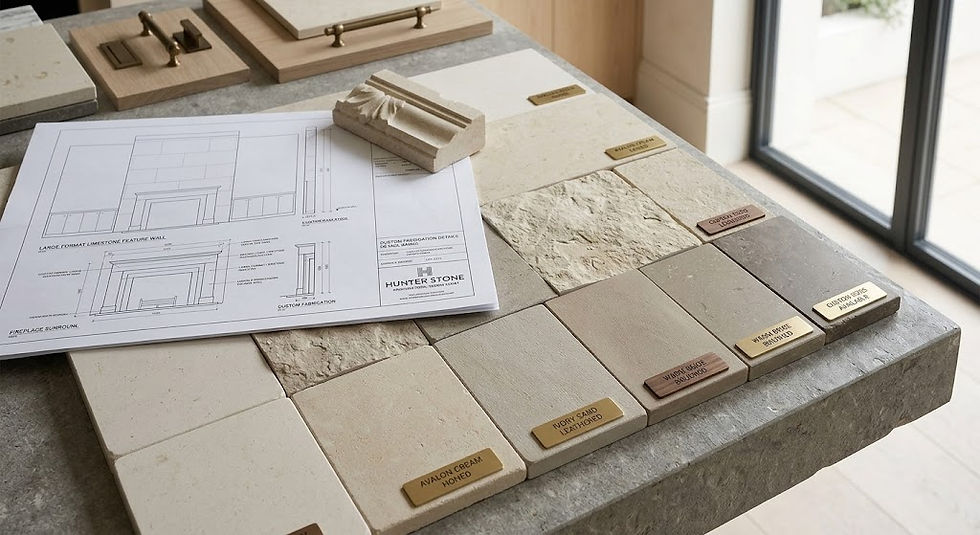
Thinking About Limestone for a Project?
Send Hunter Stone your plans, elevations, inspiration photos, or material palette.
We can help you explore limestone options and determine which colors, textures, finishes, sizes, and fabrication possibilities fit the design.
Because quiet luxury isn't about following a trend.
It's about choosing materials that won't look trendy ten years from now.
Hunter StoneNatural Stone | Cast Stone | GFRC | Custom Fabrication | Architectural Design-Assist
Sources
SurfacesGalore, Quiet Luxury in 2026: Why Limestone Is Replacing Trendy Materials, February 2026.
Delightfully Noted, 2026 Trend: Is Limestone the New Marble?, November 2025.


Comments