



2026 Outdoor Living Trends: How Stone Creates the Perfect Entertaining Space

🌿🏡 The backyard isn't just the backyard anymore.
In 2026, luxury outdoor living is becoming an extension of the home.
Outdoor kitchens are becoming more sophisticated. Fireplaces and fire pits are creating year-round gathering spaces. Covered patios are being designed like outdoor living rooms. Pools are becoming part of larger resort-inspired environments.
And one material connects almost all of these spaces:
Natural stone.
Limestone, travertine, sandstone, granite, and other natural stones can move from the floor to the walls, fireplace, kitchen, pool deck, steps, columns, and landscape.
The result is more than an outdoor patio.
It's architecture without four walls.
Let's look at some of the biggest outdoor living trends we're seeing in 2026—and how natural stone can help bring them together.

Trend #1: The Seamless Indoor/Outdoor Transition
One of the strongest movements in residential architecture is eliminating the visual boundary between inside and outside.
Large sliding and folding glass doors open entire rooms to covered patios, pools, courtyards, and outdoor kitchens.
But the doors alone don't create that connection.
The materials do.
One particularly effective strategy is to carry the same—or visually related—stone flooring from the interior to the exterior.
Imagine a large-format limestone floor beginning in the kitchen or living room and visually continuing through a wall of glass onto the covered patio.
When the colors, sizes, patterns, and elevations coordinate, the two areas begin to read as one continuous living environment.
Why Stone Works So Well Indoors and Outdoors
Natural stone has something many manufactured materials try to reproduce:
Authentic variation.
Color changes slightly from piece to piece.
Texture changes.
Mineral characteristics change.
Fossils may appear.
Veining and movement shift naturally.
Those variations allow stone to connect architecture with the landscape in a way that feels organic rather than applied.
Stone can feel refined enough for an interior while still looking completely natural outdoors.
That's a powerful combination.
Trend #2: Outdoor Kitchens Are Becoming Real Kitchens
The days of placing a grill on the patio and calling it an outdoor kitchen are disappearing—at least in luxury outdoor design.
Today's outdoor kitchens may include:
🔥 Built-in grills🍕 Pizza ovens🧊 Refrigeration🍷 Beverage centers🚰 Sinks🗄️ Storage🍽️ Large preparation areas📺 Entertainment systems🪨 Stone countertops and cladding
These spaces are being designed for actual entertaining.
And because the kitchen becomes such a significant visual element, material selection matters.
Natural stone can be incorporated into:
Countertops
Islands
Bar tops
Wall veneer
Pizza oven surrounds
Columns
Backsplashes
Flooring
Steps
Architectural details
The goal should be to make the outdoor kitchen feel like it belongs to the architecture—not like equipment added to the patio afterward.

Trend #3: Fire Pits Are Becoming Gathering Spaces
🔥 Few elements bring people together outdoors like fire.
But in 2026, the fire pit itself is becoming more architectural.
Instead of a portable metal fire pit, designers are incorporating permanent fire features into the overall landscape.
We're seeing:
Natural stone fire pits
Linear fire features
Large stone hearths
Built-in seating
Sunken conversation areas
Stone retaining walls integrated with fire
Sculptural fire features
The stone can coordinate with the house, pool, patio, or landscape walls so the fire feature feels intentional.
The best outdoor fire spaces aren't simply something you look at.
They're designed around how people gather.
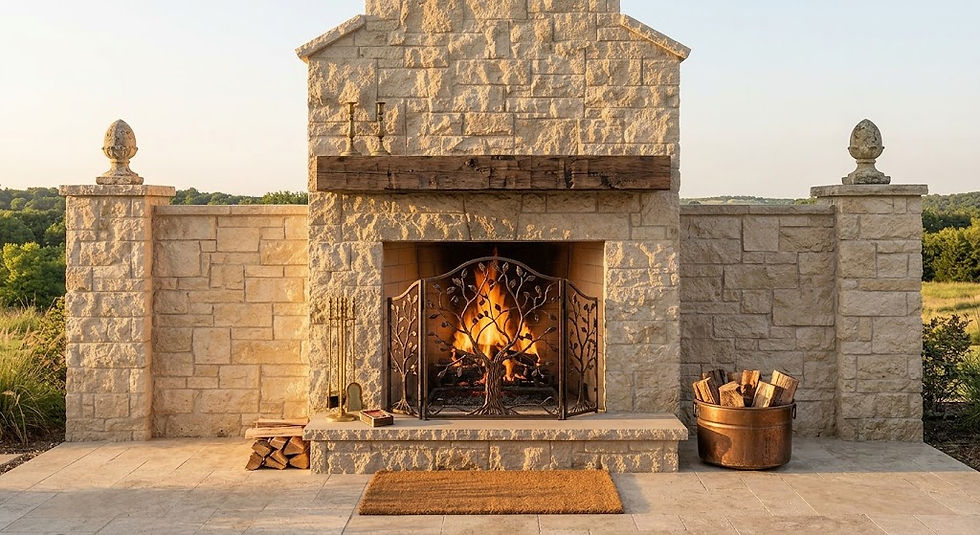
Trend #4: Outdoor Fireplaces Become the Anchor
A fireplace can completely change an outdoor space's character.
It creates a visual destination.
It provides scale.
It gives furniture something to organize around.
It can also make a covered patio feel more like an outdoor room.
Natural stone fireplaces can range from rustic full-bed masonry to clean contemporary limestone.
The design might include:
Tumbled limestone
Natural thin veneer
Full-bed stone
Large-format stone panels
Custom-cut surrounds
Stone mantels
Hearths
Caps
Carved architectural details
The important question isn't simply:
“What stone should we use?”
It's:
“What role should the fireplace play in the space?”
Trend #5: Limestone Is Everywhere
🤍 Limestone fits exceptionally well with today's preference for warm, natural, understated outdoor environments.
Cream.
Buff.
Ivory.
Sand.
Taupe.
Soft gray.
These colors complement landscaping rather than competing with it.
Limestone also pairs beautifully with many of the materials dominating luxury outdoor architecture:
Limestone + Wood
Limestone + Glass
Limestone + Black Metal
Limestone + Stucco
Limestone + Water
That versatility allows the same material family to work across contemporary, Mediterranean, transitional, traditional, and resort-inspired architecture.
Trend #6: The Pool Deck Is Part of the Architecture
A pool isn't an isolated feature anymore.
It's increasingly being designed as part of the entire outdoor environment.
That means the material surrounding the pool becomes extremely important.
Natural stone can potentially be used for:
Pool decking
Coping
Steps
Waterline features
Raised walls
Waterfalls
Fountains
Planters
Outdoor showers
Adjacent patios
But pool environments require careful material selection.
Not every stone or finish suits every application.
Important considerations include:
Slip resistance
Surface temperature
Water absorption
Freeze/thaw conditions where applicable
Salt or chemical exposure
Finish
Maintenance
Thickness
Installation method
The prettiest stone isn't necessarily the best pool stone.
Performance matters.

Trend #7: Larger-Format Stone Pavers
We're also seeing outdoor spaces move toward cleaner, larger paving formats.
Larger stone pieces can create:
Fewer joints
Cleaner visual lines
More contemporary spaces
Greater continuity
A stronger indoor/outdoor connection
Rather than thinking only in traditional small paver dimensions, designers can explore larger limestone and natural stone formats when the material and installation conditions allow.
This becomes particularly effective when large-format pieces relate directly to interior flooring.
Trend #8: Stone on Pedestal Systems
Another opportunity is using stone pavers with pedestal systems.
Pedestal applications can be useful for:
Rooftop terraces
Balconies
Elevated patios
Podium decks
Outdoor amenity spaces
The system creates space beneath the finished surface for drainage and, depending on the design, utilities or other building requirements.
For architects and contractors, this can open opportunities to incorporate natural stone into areas where a conventional mortar-set installation may not be the preferred solution.
The stone thickness, size, strength, pedestal spacing, and complete system requirements need to be evaluated together.
Trend #9: Limestone Balustrades and Architectural Details
Outdoor living isn't limited to flooring and kitchens.
Traditional architectural details are also returning in more refined ways.
Limestone and cast stone can be used to create:
Balustrades
Columns
Pier caps
Wall caps
Steps
Sills
Copings
Benches
Fountains
Planters
Decorative surrounds
A limestone balustrade overlooking a pool or garden can immediately change a property's architectural character.
In contemporary projects, those same elements may be simplified into clean profiles rather than traditional ornamentation.
The material can remain timeless while the detailing changes with the architecture.

Trend #10: Modular Seating and Sculptural Stone
Outdoor furniture is becoming more architectural too.
Rather than filling a patio with lightweight pieces, luxury outdoor environments are incorporating substantial elements that feel connected to the landscape.
That may include:
Built-in stone benches
Seat walls
Stone tables
Sculptural stone elements
Large planters
Water features
Custom-cut blocks
Integrated seating around fire features
Stone doesn't always have to be cladding.
Sometimes the stone itself becomes the object.
Create Zones, Not Just a Patio
One of the biggest differences between an average patio and a great outdoor entertaining space is how you organize the area.
Think about creating distinct zones:
Cooking
Outdoor kitchen, grill, pizza oven, prep space, and bar.
Dining
A dedicated table positioned near the kitchen.
Conversation
Comfortable seating organized around a fireplace or fire pit.
Pool
Lounging, sun areas, shade, and water access.
Quiet Space
A smaller seating area away from the main activity.
Transition
The area connecting the interior of the house to the outdoor environment.
Stone can visually connect all of these zones without requiring them to look identical.
You Don't Have to Use the Same Stone Everywhere
A seamless outdoor environment doesn't mean every surface needs to match.
In fact, using one material everywhere can sometimes make the project feel flat.
Instead, think in terms of a stone palette.
For example:
Honed limestone inside
↓
Textured limestone outside
↓
Tumbled limestone on the fireplace
↓
Matching limestone coping around the pool
The color family stays connected while the finishes change to suit the application.
That's a much more sophisticated approach than simply selecting one stone and putting it everywhere.
Texture Becomes Extremely Important Outdoors
Exterior stone has different performance requirements from interior stone.
A smooth finish that works beautifully inside may not provide the slip resistance you want outdoors.
That's why you should consider the indoor/outdoor transition carefully.
The same stone may potentially be fabricated with different finishes:
Interior: Honed
Covered Exterior: Lightly textured
Pool Area: More slip-resistant finish
The visual relationship remains consistent while the surface responds to its environment.
This is where early material planning becomes extremely valuable.

Don't Forget Drainage
Beautiful outdoor spaces still have to deal with water.
Before finalizing stone, consider:
Drainage slopes
Waterproofing
Deck drains
Door thresholds
Weep systems
Pedestal systems
Pool drainage
Wall flashing
Movement joints
Substrate conditions
These aren't glamorous details.
But they're often the difference between a beautiful outdoor space and an expensive problem.
Design and performance have to work together.
Natural Stone Creates Permanence
Outdoor furniture changes.
Landscaping grows.
Technology becomes outdated.
But the architecture remains.
That's why natural stone is such a powerful material for outdoor living.
A properly selected stone fireplace, terrace, pool deck, wall, or outdoor kitchen can become part of the property, not just the décor.
And as the stone naturally ages, it can become even more integrated with the landscape.
Start Designing the Outdoor Space Earlier
One mistake we see is treating outdoor living as something to figure out after the house is designed.
That's too late.
If the goal is a truly seamless indoor/outdoor environment, start exterior decisions while the architecture is still being developed.
Consider:
Where do the interior and exterior floors meet?
What is the finished floor elevation?
Where does water drain?
How thick is the exterior stone?
What happens at the door threshold?
Where does the outdoor kitchen connect to utilities?
What structural support is required?
How does the fireplace relate to the roof?
What stone surrounds the pool?
How do the materials transition?
Solving these questions early can dramatically improve the finished project.

Hunter Stone Can Help Build the Stone Palette
At Hunter Stone, we don't look at outdoor living as a single-product project.
We can help architects, landscape architects, interior designers, builders, contractors, and homeowners develop a coordinated stone package that may include:
Natural stone flooring
Limestone pavers
Travertine
Pool coping
Steps
Wall veneer
Thin veneer
Full-bed stone
Outdoor kitchens
Fire pits
Fireplace surrounds
Mantels
Wall caps
Columns
Balustrades
Pedestal paver systems
Custom fabrication
Cast stone
GFRC
We can also assist with material selection, samples, takeoffs, shop drawings, design-assist, specifications, installation recommendations, fabrication, and logistics.
Because the goal isn't simply to select beautiful stone.
It's to make all the pieces work together.
Planning an Outdoor Living Project?
Send Hunter Stone your plans, landscape drawings, elevations, renderings, inspiration photos, or material palette.
We'll help you explore natural stone options for the floors, pool, kitchen, fireplace, walls, steps, and architectural details—and help develop a stone package that connects the entire project.
🌿 The best outdoor spaces don't feel like an addition to the home.
They feel like the home simply continued outside.
Hunter StoneNatural Stone | Cast Stone | GFRC | Custom Fabrication | Architectural Design-Assist
Source
Splendour in Stone — Natural stone landscaping and outdoor design inspiration


Comments