


Stone Fireplace Mantels: The Ultimate Statement Piece for 2026
- Quentin Hunter

- 2 days ago
- 6 min read
For generations, the fireplace has been the heart of the home.
In 2026, it's becoming something more.
It's becoming architecture.
Designers are moving beyond the traditional idea of a fireplace as simply a firebox with a mantel above it. Natural stone walls, cast stone surrounds, floor-to-ceiling installations, floating profiles, contrasting materials, and custom architectural details are transforming fireplaces into major focal points.
And one thing is becoming clear:
The fireplace doesn't have to be decorated to make a statement. The material can make the statement.
The Fireplace Is Becoming an Architectural Feature
Homeowners in 2026 are showing greater interest in natural materials, organic textures, and substantial fireplace surrounds.
Floor-to-ceiling treatments are particularly noteworthy.
Instead of stopping the material immediately around the firebox, designers can carry stone vertically—sometimes all the way to a vaulted ceiling.
That changes the room's visual scale of the entire room.
The fireplace is no longer an accessory.
It becomes part of the architecture.

Natural Stone Is Replacing the Shiny Look
Another major change is happening with finishes.
Highly polished surfaces aren't the only way to communicate luxury.
In fact, 2026 fireplace trends are leaning toward materials that look and feel more natural.
Electric Fireplaces Direct specifically identifies honed, matte, and natural-looking stone finishes as a significant direction for 2026.
Textured natural stone—including rough-hewn limestone, split-face stone, tumbled marble, and natural-cleft slate—is an alternative to highly polished surfaces.
That creates an entirely different feeling.
Instead of reflecting light, these finishes interact with it.
Texture creates shadow.
Variation creates movement.
And natural stone gives the fireplace character that changes throughout the day.
Cast Stone Mantels Are Making a Statement
Natural stone isn't the only option.
Cast stone offers architects and designers another way to create substantial fireplace surrounds.
Cast stone is a material that creates a premium, built-in appearance while providing durability and design flexibility.
Cast stone can work particularly well when the design calls for:
Traditional mantel surrounds
French-inspired architecture
Transitional interiors
Large architectural profiles
Repetitive components
Detailed molding
Custom shapes
Consistent coloration
The important point is that cast stone doesn't have to look overly ornate.
Today's cast stone fireplace can be traditional—or remarkably contemporary.
The profile determines the personality.

Two-Tone Fireplace Surrounds
Contrast is also returning.
Electric Fireplaces Direct identifies two-tone fireplace designs as one of its major mantel trends for 2026.
Think:
Light stone + dark mantel.
Warm limestone + black steel.
Cream cast stone + dark wood.
Natural stone + plaster.
Stone + aged brass.
Rather than matching every material, designers are intentionally creating contrast.
Done correctly, a two-tone fireplace can add depth without making the room feel busy.
The key is restraint.
Contrast should emphasize the architecture—not compete with it.
The Rise of the Floating Mantel
One of the cleanest fireplace looks works by removing visual weight.
The floating mantel creates a simple horizontal element above the fireplace without traditional legs or pilasters extending to the floor.
Mantels Direct identifies floating mantel shelves as an important contemporary fireplace option, particularly for modern and minimalist interiors.
The concept can also inspire custom stone design.
Imagine a substantial stone shelf seemingly floating above a linear fireplace.
Or a simple limestone slab projecting from a full-height stone wall.
Minimal profile.
Maximum impact.
That's one of the defining characteristics of contemporary luxury:
The detail looks simple—but achieving that simplicity requires careful design.

Texture Is Becoming the Decoration
One of the most interesting changes in luxury interiors is the shift from adding decoration to a surface to making the surface itself decorative.
Natural stone is ideal for this.
Designers can work with:
Honed surfaces
Sandblasted finishes
Bush-hammered textures
Brushed stone
Tumbled stone
Split-face material
Natural cleft
Carved patterns
Linear grooves
Fluting
Custom relief
A fireplace wall doesn't necessarily need artwork hanging on it.
The stone can become the artwork.
Fluted and Carved Stone Details
Fluting is particularly interesting because it brings together classical architecture and contemporary design.
Fluted columns have existed for thousands of years.
But when the same concept is simplified and applied to a fireplace surround, limestone panel, or mantel face, it can feel remarkably modern.
Vertical grooves create shadow lines.
Lighting changes those shadows throughout the day.
The fireplace gains depth without requiring multiple materials or dramatic colors.
Custom carving takes the concept even further.
A fireplace can incorporate:
Fluted panels
Geometric relief
Traditional moldings
Family crests
Decorative motifs
Custom profiles
Sculptural stone elements
This is where a fireplace stops being a catalog selection and becomes custom architecture.

Natural Stone Fireplace Walls
For larger rooms, one of the most dramatic approaches is a full wall of natural stone.
Fireside Hearth & Home identifies floor-to-ceiling fireplace surrounds as a significant 2026 direction, particularly in great rooms, open-concept spaces, and rooms with tall or vaulted ceilings.
Depending on the architecture, possibilities can include:
Limestone for a soft, refined appearance.
Travertine for warmth and movement.
Marble for stronger veining and drama.
Granite where durability and distinctive mineral character are desired.
Natural stone veneer for texture and dimensionality.
The right choice depends on the architecture.
There isn't one “best fireplace stone.”
There's a stone that's appropriate for your fireplace.
Scale Matters More Than Ever
One of the easiest mistakes to make with a fireplace is choosing a mantel that doesn't match the room's scale.
A small mantel in a great room with a 20-foot ceiling can disappear.
An oversized traditional surround in a smaller contemporary room can overwhelm everything around it.
That's why fireplace design should consider more than the firebox opening.
Look at:
Ceiling height.Wall width.Firebox dimensions.Mantel projection. Surround width . Furniture placement.TV location.Adjacent cabinetry.Stone thickness.Overall room proportions.
The fireplace should be part of the room.
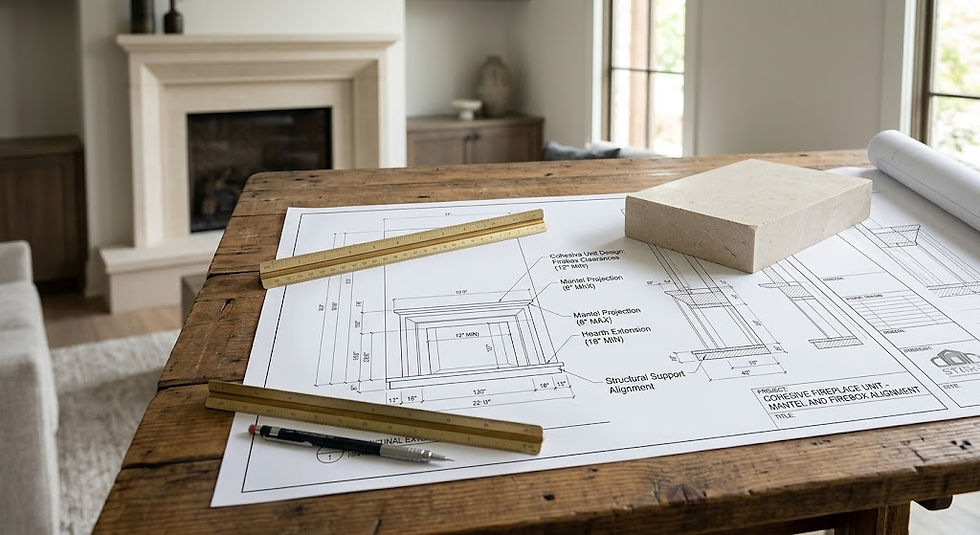
Don't Design the Mantel Separately From the Fireplace
This is especially important with custom stone.
The firebox, mantel, hearth, surround, wall material, clearances, and structural support must all work together.
Mantels Direct emphasizes that mantel height and placement must account for fireplace type, projection depth, manufacturer requirements, and applicable clearances.
A beautiful mantel that's incorrectly proportioned—or doesn't meet the fireplace manufacturer's requirements—isn't good design.
Design and detailing have to work together.
Natural Stone or Cast Stone?
We get this question frequently.
The answer depends on what the project is trying to accomplish.
Natural Stone
Natural stone provides geological variation, authentic texture, and the opportunity for one-of-a-kind fabrication.
It can be ideal when the design calls for:
Natural limestone
Marble
Travertine
Granite
Large slabs
Bookmatching
Hand or CNC carving
Custom architectural components
Cast Stone
Cast stone can provide greater consistency and flexibility when producing architectural shapes, repeated pieces, moldings, surrounds, and detailed components.
It can be especially effective when the architecture requires a controlled profile and consistent appearance.
Neither material is automatically better.
The architecture should determine the material—not the other way around.
Custom Means More Than Choosing a Color
A truly custom stone fireplace involves much more than selecting “white limestone” or “cream cast stone.”
The design can consider:
Overall dimensions
Mantel height
Mantel projection
Leg or pilaster width
Hearth dimensions
Stone thickness
Edge profiles
Joint locations
Finish
Texture
Carving
Fluting
Panel layout
Attachment methods
Installation sequence
That'ss why involving the stone fabricator early can make such a difference.
A detail that's easy to draw may be difficult to fabricate.
And sometimes a small change in a detail can make fabrication, shipping, or installation significantly more efficient.
The Fireplace Should Be Designed With the Room
One of our favorite questions to ask isn't:"
"What mantel do you want?”
It's:"
"What do you want this room to feel like?”
Warm and traditional?
Clean and contemporary?
Old-world European?
Mediterranean-modern?
Minimal?
Grand?
Rustic?
Quiet luxury?
Once we understand the architecture and the feeling the designer is trying to create, selecting the stone becomes much easier.
That's the difference between selling a mantel and designing a fireplace.
Let Hunter Stone Help You Create the Fireplace
At Hunter Stone, we work with architects, interior designers, builders, contractors, masons, and homeowners to develop natural stone and cast-stone fireplace solutions.
Our capabilities can include:
Natural stone mantels
Cast stone mantels
Fireplace surrounds
Full-height stone walls
Custom limestone fabrication
Hearths
Mantel shelves
Fluted stone
Custom carving
Architectural profiles
Shop drawings
3D modeling
Material selection
Samples
Installation recommendations
Project coordination
If you're designing a custom home, luxury residence, hospitality space, clubhouse, or other project where the fireplace needs to become an architectural centerpiece, send us the plans, elevations, renderings, or inspiration images.
Don't start by asking:"
"Which mantel should we buy?”"
Start with:"
"What could this fireplace become?”"
Then let the architecture determine the answer.
Because the best fireplace isn't simply part of the room.
It's the piece that defines it.
Sources & Further Reading
Fireside Hearth & Home — “Top Design Trends in Fireplace Mantle Surrounds for 2026” Identifies natural materials, organic textures, textured natural stone, dramatic scale, floor-to-ceiling surrounds, oversized mantel shelves, and wide fireplace wall treatments as important 2026 trends.


Comments